
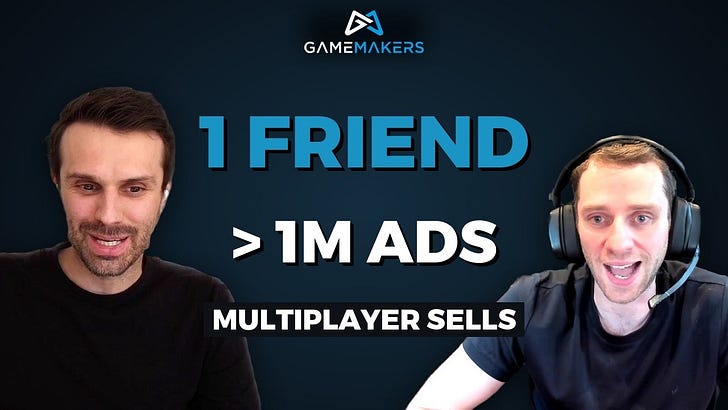

A few weeks ago I talked with Pedro Esparza about why studios should watch what players do instead of what they say. Pedro is Head of Growth at BisectHosting, and the obvious follow-up was to talk to the two people who started the company.
Max Podkidkin (CEO) and Andrew Blatchford (CTO) met as players on a Minecraft server. Max lives in the US, Andrew in the UK, and for years the two of them ran 24/7 support between them. Today BisectHosting is a bootstrapped business of roughly $35 million a year, with nearly a hundred staff and about two million servers, and they never raised outside money, per BisectHosting's co-founders and head of growth.
I wanted two things from this conversation. The first was the founder story: how two gamers turned a frustration into a company without venture money. The second was what they see from where they sit. Hosting tens of thousands of game communities gives you a view of player behavior that most studios never get.
My claim: when players put real effort into adding multiplayer to your game, they're showing you sales you're missing. Max and Andrew also gave me the cases where that isn't true, and I'll get to those.
One disclosure up front. BisectHosting sells game servers, so Max and Andrew have a natural interest in studios supporting multiplayer and community hosting. As with Pedro, I don't think that undermines the argument, and they're blunt about when a game shouldn't be multiplayer at all. But you should know it.
Part 1: The gap they lived as players
The origin story is a good lesson in finding an opportunity. Max was playing on a Minecraft server that kept going down, so he spun up his own as a refuge. When the original server came back, the players who'd built things on his asked him to keep it running. He outgrew his home connection, then shared hosting, then a VPS, then rented dedicated servers, and eventually they owned their own hardware.
Along the way they learned what it was like to be a customer of a hosting company:
"You're waiting sometimes hours to days to sometimes a week to even get that reply. So you're like, great, I waited for a week and you gave me a useless reply."
What turned it into a business was noticing the same problem in other communities. Andrew described a larger server they knew that was having exactly the same issues:
"That's when we started seeing that pattern where you see these communities often having issues regularly enough that you kind of start seeing that gap of, wait a second, no one's really doing this right at the moment."
That server became their first customer. Max's version of the lesson is simple: if something frustrates you, it probably frustrates many other people too. His standard for support came from outside games entirely. If a restaurant makes you wait 20 minutes past your reservation, a small acknowledgment changes how you feel about it. "I love good customer service, and I feel like it's very easy to provide." Even when the problem is a mod or the game itself, they research it instead of telling the customer it isn't their end.
I asked Max what a server is like for a player, because a lot of GameMakers readers come from mobile. His answer is the core of everything that follows:
"I think if there was no multiplayer and these servers in Minecraft, Minecraft would not be where it is today. It would not be, you know, the most downloaded game ever."
When he first played Minecraft, he played single-player for about a week, found a way to cheat, got all the diamonds he wanted and got bored. Joining a server with other people changed the game completely, even when he was doing things he'd already done.
Part 2: Bootstrapping on purpose
We're in a very different funding environment than five years ago. Plenty of games and game-adjacent companies were funded then that probably shouldn't have been, and money is much harder to get now. That makes the bootstrapped path more relevant, so I asked what it taught them.
Andrew's answer was that slow growth is what kept them independent. Thirty percent growth when you have ten customers is nothing, but compounded over ten to fifteen years it gets you to scale, without the twenty-times year that sends you chasing funding.
Being bootstrapped also meant they did every job themselves. Andrew tells every new hire that he and Max have done every role in the company, and that's why they can set direction for each one:
"If we were to have had unlimited funding, technically, or even just a few million dollars to pay for more staff, me and Max probably would have never done any of those jobs."
Max called outside funding a set of golden handcuffs. Investors need an exit and want their money back, which is fair, and it lets some companies take huge risks. But their goal was a sustainable service, and it let them decide what was best for customers "and not necessarily always for our bottom line." Andrew put the contrast plainly: funded companies "spend, spend, spend, and then the cuts come later." They had to be frugal from day one, which meant they never needed the funding and never had anyone to answer to when they wanted to spend a few million dollars on hardware.
There's a co-founder lesson in here too. Max admitted that for a long time he and Andrew barely spoke beyond Google Chat. No calls, no meetings. Things got better once they got to know each other personally ("me saying, like, hey, do you have a couple of minutes, and then it's like a two-hour conversation"). They also had different work ethics early on, because Andrew was just starting university and Max was further along, which led to some hard conversations about whether they were both serious. Andrew's rule for co-founders is respect and no big egos, so neither person is certain they're right when they might not be.
Part 3: Why multiplayer sells the game for you
Then we got to the opportunity. Players have been adding multiplayer to games designed for solo play for as long as both of them can remember, and I asked what developers should learn from that.
Max's answer is the mechanism behind my claim. Some games look appealing, but not enough for someone to buy and play alone. Add a way to play with a friend and the decision changes:
"Then that's huge, because then instead of making one sale, they're gonna sell two copies of the game. And then that just could grow from there. It doesn't have to be just one friend. It could be a group of friends."
Andrew called it "free marketing." You can't play a multiplayer game without friends who play it too, so the game recommends itself. He has bought copies of games for his friends just so they could play together. And it compounds: friends bring their friends, and it spreads to streamers whose viewers want the same experience with their own groups. Max put it in a line I'll be repeating for a while:
"I could get a million ads for something and I'll have zero interest. But if one friend's like, hey, you should get this, I'm gonna go buy it instantly."
I shared my own theory here. During COVID I watched my kids, and they were increasingly all on Discord together. Choosing a game stopped being an individual decision and became a group one: let's jump on Valorant, let's play this tonight. Andrew pointed to the rise of short, curated co-op experiences (the "friendslop" genre) and shorter attention spans: games you play for 20 or 30 minutes with friends, then move on. That's part of why Roblox and Fortnite are so big, he said. They offer lots of smaller experiences instead of one massive world.
Max admitted he doesn't have much time for games anymore, but when he sees a friendslop trailer he goes straight to their Slack and asks for another game night. He'll happily replay a game from the start if it means playing it with someone new.
Studios haven't always welcomed this. Max's example was Rockstar, which was not happy with the FiveM community for GTA V and then ended up buying it, "because the amount of time and effort the community put into it is like absolutely insane."
Part 4: Your players are already telling you
So how does a studio know? Max's first answer was to look at what the community is already doing with your game. Are players repeatedly asking for co-op? Are people building multiplayer mods? If dozens or hundreds of people are making mods, it's worth a closer look. His reasoning is about time:
"Nobody can get their time back. You can get anything you want in the world somehow, maybe, but we all have a limited amount of time. And if somebody's willing to spend their time modding your game, I think it's worth taking a closer look at."
When I pushed on data, because a lot of studios say "we have to be data-driven," his answer was the same one Pedro gave me:
"I think in general the strongest signal for the studio is when their own players are solving the problems themselves."
There's no chart that tells you to do it, he said. You have to go into the communities. Discord is where they live: join the servers, lurk, see where the conversations go, and contact the people who are most vocal. Ask them why they think it would work and what they like about your game. It's manual work, which is probably why some studios skip it. I'll admit this one landed for me. As someone with an MBA, I know how much people with my background avoid that kind of on-the-ground work.
Andrew added two points from the technical side. First, setup has to be easy: "No one wants to spend an hour setting it up whilst their friends are shouting at them saying, I want to play this game. They'll just move on to something else." Second, think about the multiplayer stack from the start. It's much harder to add once the game is built, and he sees more studios leaving it low on the priority list until the community starts asking. He also noted that games with multiplayer generally stay relevant much longer.
Part 5: When multiplayer is the wrong call
I didn't want this to become "every game should be multiplayer," so I asked directly when a single-player game should stay that way.
Andrew mentioned games like Mario. Max pointed to games built on solitude and personal story choices, the Zelda kind of experience you're happy to enjoy alone. But both thought the list of games people would love to share is much longer than the list that should stay solo.
Andrew's strongest warning was about the future cost:
"Certain games have disappeared completely because they've lost the multiplayer backend that was running it."
His rule: if you can't support community servers, don't have an unlimited budget to run servers forever, and don't have an off-ramp plan such as releasing source code to the community, you shouldn't be doing multiplayer. It doesn't have that longevity.
He also described the common mistakes they see across their customers:
Solving the wrong problem. Building multiplayer that's outside the scope of what the game is, or pushing too hard (or not enough).
Host-only worlds. Co-op where one player hosts the shared world, so nobody can play when that friend is offline. Andrew called out Schedule I as a big example. Players spend hours or days in a world and then have to wait for the host to come online.
Forgetting the cost into the future. Community-funded hosting lets players who care pay for servers, so developers can spend on the game instead of infrastructure. A lot of companies now run a hybrid: official servers plus community servers, and community servers carry it when player numbers drop, "so the game continues on into history."
Part 6: The cheapest test
Finally, I asked the bootstrapper's question. If you're a small team with a single-player game that's working, what's the cheapest way to find out whether multiplayer demand is real?
Max's sequence:
Start with the community. Look for multiplayer mods, projects in development, and groups organizing around them. Check Steam discussions and Discord for repeated co-op requests.
Talk to the people behind it. Why did they start? Was it for themselves, a group of friends, or a need they saw somewhere else?
Test the mod with its creator. Watch who plays, and whether it's one session or a group that keeps coming back.
Ask for a small commitment. A sign-up list for email or notifications. A hundred people may say they'd love it, but how many fill out a form? All of them, half, or one?
Partner with what exists, or buy it. Modders are often working in their spare time, and some would happily hand a project over, for very little or even free, if they know it'll end up in the game.
That fourth step is the same principle Pedro described: commitment beats stated interest.
A note on AI
We ended on AI. Max was candid that it has hurt the hosting business in one way, because RAM and chip prices have climbed so much that a gaming PC costs far more than it did a year and a half ago. On the positive side, they added an assistant called Biko to their control panel. It can see a customer's files (with permission) and answer from their knowledge base in seconds, where their human team already averages under 15 minutes. Max is proud that they made no cuts to the support team after Biko launched. People moved to other departments, and the ones who stayed have more time for the complex problems.
Andrew's view is that the mistake is treating AI as the solution and getting rid of everyone. For them it's a tool that lets the same people do more. Max described an engineering hackathon where the team built remarkable things in four hours. AI can get you maybe 80% of the way, he said, but the final 20% that makes something polished and working as intended still takes the real effort. His closing analogy was the news stories about people who follow GPS into a river.
Key takeaways
Your own frustration can be a market. BisectHosting started because two players couldn't get decent support, then saw the same problem across other communities.
Bootstrapping is a choice with benefits. Slow compounding growth kept them independent, and doing every job themselves meant they could set direction for every role.
Multiplayer turns one sale into a friend group. Word of mouth is free, and one friend's recommendation beats a million ads.
The strongest signal is players solving it themselves. Mods, co-op requests, and communities organizing around your game are worth investigating, by talking to the people involved.
Don't ship multiplayer you can't keep alive. Without community servers, a long-term budget, or an off-ramp, the game can disappear when the backend does.
Test cheaply before you build. Talk to modders, ask for a small commitment, and consider partnering with or buying what already exists.
If you have a single-player game with any traction, my suggestion for this week: search your Discord, Steam discussions, and mod sites for "co-op" and "multiplayer," and count how many people are already trying to play your game together.
The full 75-minute conversation is in the audio player above, on Spotify, and on YouTube. The video at the top is the 33-minute edit.
