
Kalie Moore ran the prompts across ChatGPT, Gemini, and Perplexity. What came back turns game discoverability into a PR problem, and she gave me the playbook she uses to fix it.
When I ask people in games what PR is for, I often get the same answer. It is an event business: You raise a round, you announce it, you get the hit, and then you go quiet until the next launch. Discoverability lives somewhere else entirely, under user acquisition, store optimization, and chart position.
So I brought on Kalie Moore to explain her point of view. She runs High Vibe, a PR agency that works with game studios and the infrastructure companies in our industry. She has been Pocket Worlds’ agency of record for three years; she has worked with Overwolf for six, and she ran Sky Mavis’ PR for five.
She also built a product, PRCoverage.ai, that measures whether a given piece of coverage is being cited by the models. I wanted someone who could answer from client data, and she is one of the few people who can.
I started with the basic version: What does PR actually do for a studio?
She said comms is creating a narrative for your company or your game, and “PR is a subset of that, and it’s all about securing earned media.”
In my view, PR is all about the game of attention, and I laid out the three levels I usually think in:
Attention for the game
Attention for the studio
Attention for the individual
She had already raised the B2B side herself, which she thinks is increasingly important for hiring and for reaching publishing partners and investors.
The best mobile puzzle game came out in 2014
Kalie asked ChatGPT for the best mobile puzzle game. She told me she expected Candy Crush, or Royal Match, or something else off the top of the grossing charts. “It wasn’t,” she said. “It was Monument Valley, a game that came out over 10 years ago in 2014.”
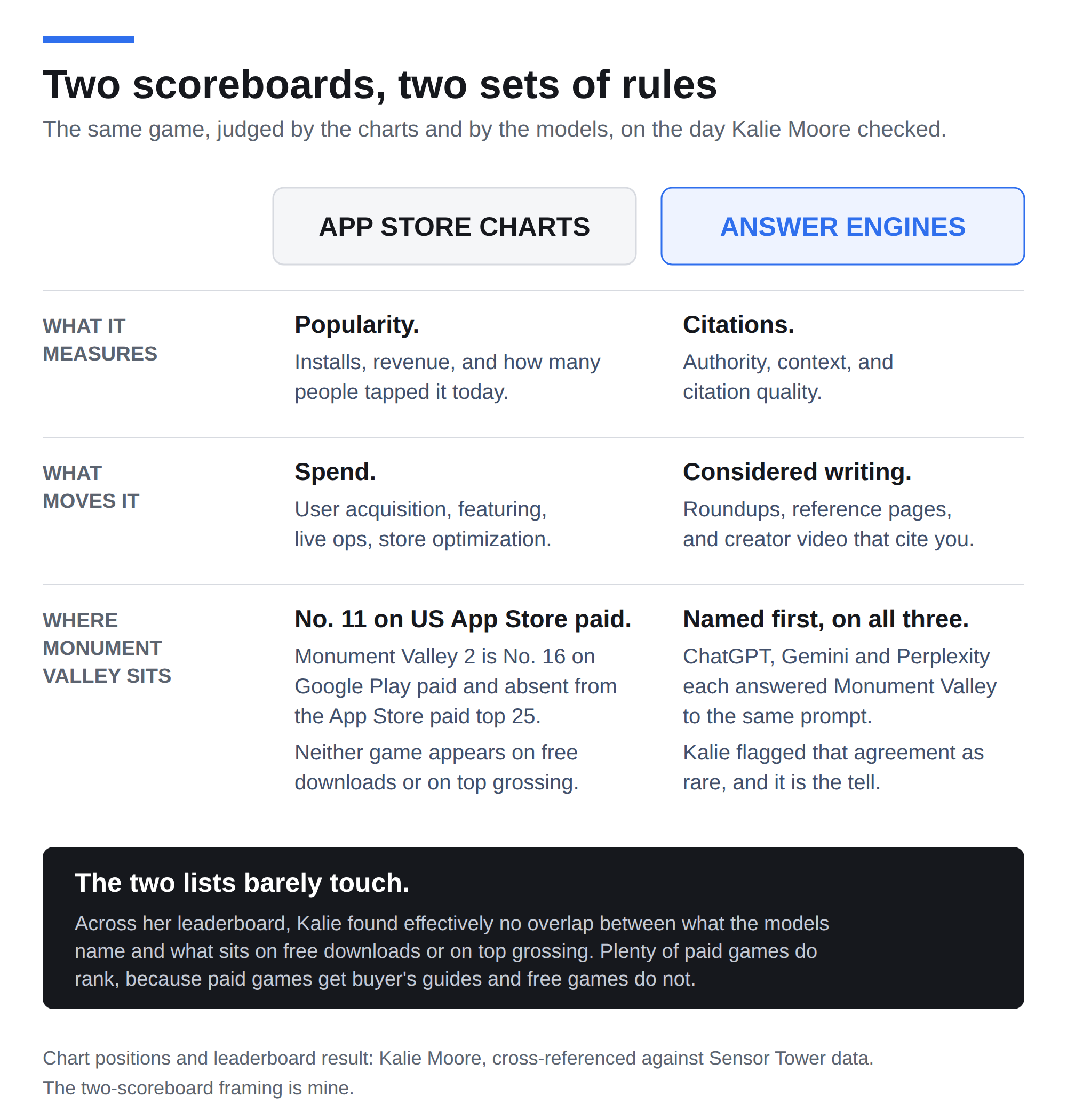
I wanted the comparison numbers rather than the anecdote, and she had already pulled them. In the US App Store, Monument Valley ranks #11 in paid. Monument Valley 2 sits at #16 on Google Play paid and doesn't appear in the App Store paid top 25 at all. Neither game shows up anywhere on free downloads or on top-grossing. She then ran the same prompt on Gemini and Perplexity, and all three named Monument Valley. She pointed out how rare that is, and it is the detail I would flag hardest. The models usually disagree.
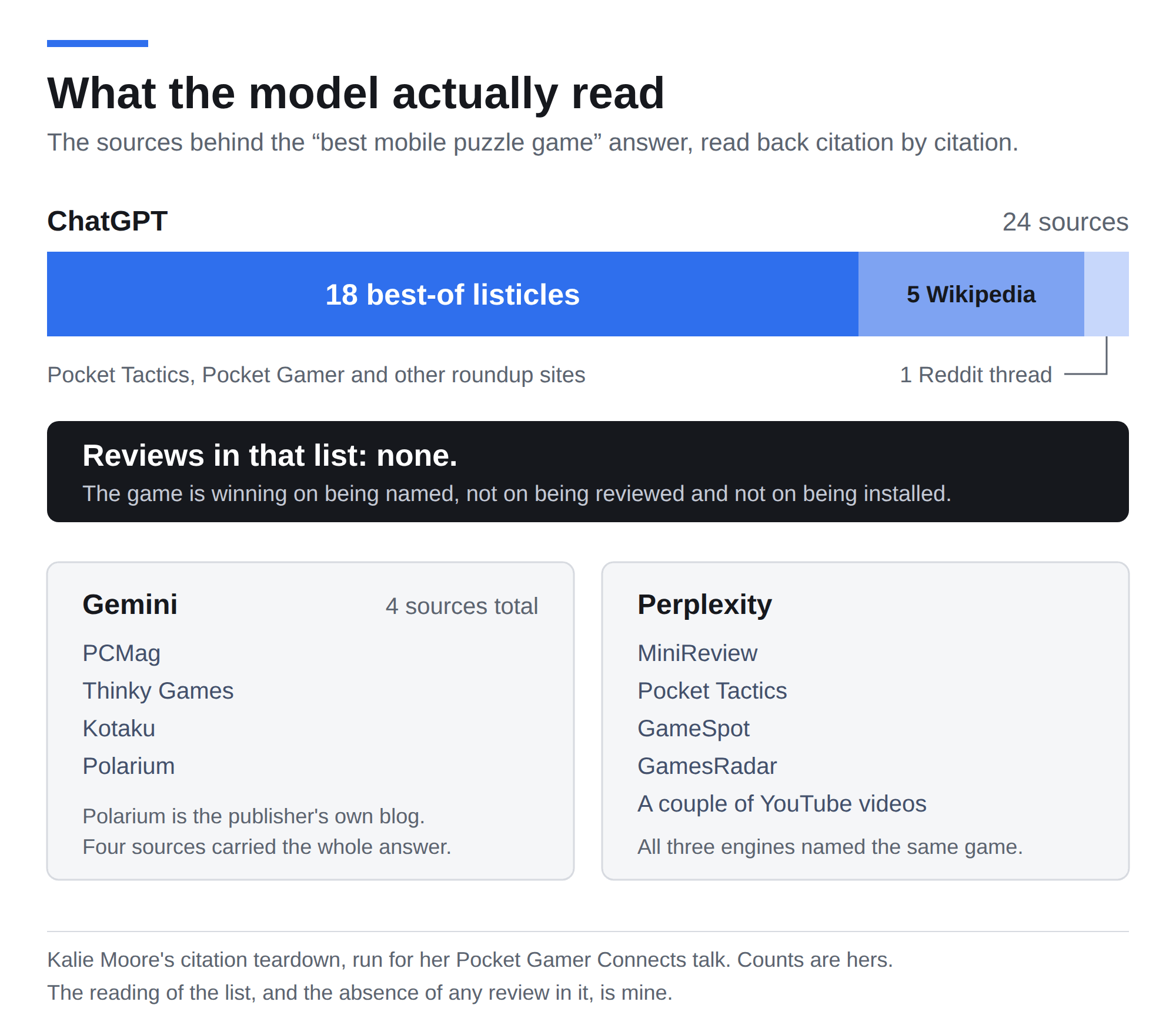
What I find more useful than the answer is the sourcing behind it. When she checked ChatGPT’s citations, the answer was drawing on 24 sources. Eighteen were best-of listicles from sites like Pocket Tactics and Pocket Gamer. Five were Wikipedia. One was Reddit. Perplexity leaned on MiniReview, Pocket Tactics, GameSpot, GamesRadar, and a couple of YouTube videos. Gemini used four sources for its entire answer: PCMag, Thinky Games, Kotaku, and Polarium, which is the publisher’s own blog.
I went through that list twice looking for a review, and there is not one. “They’re roundups that happen to just list them,” Kalie said. The game is winning on being named. It is not winning on being reviewed, and it is certainly not winning on being installed.
App stores measure popularity. The models measure citations.
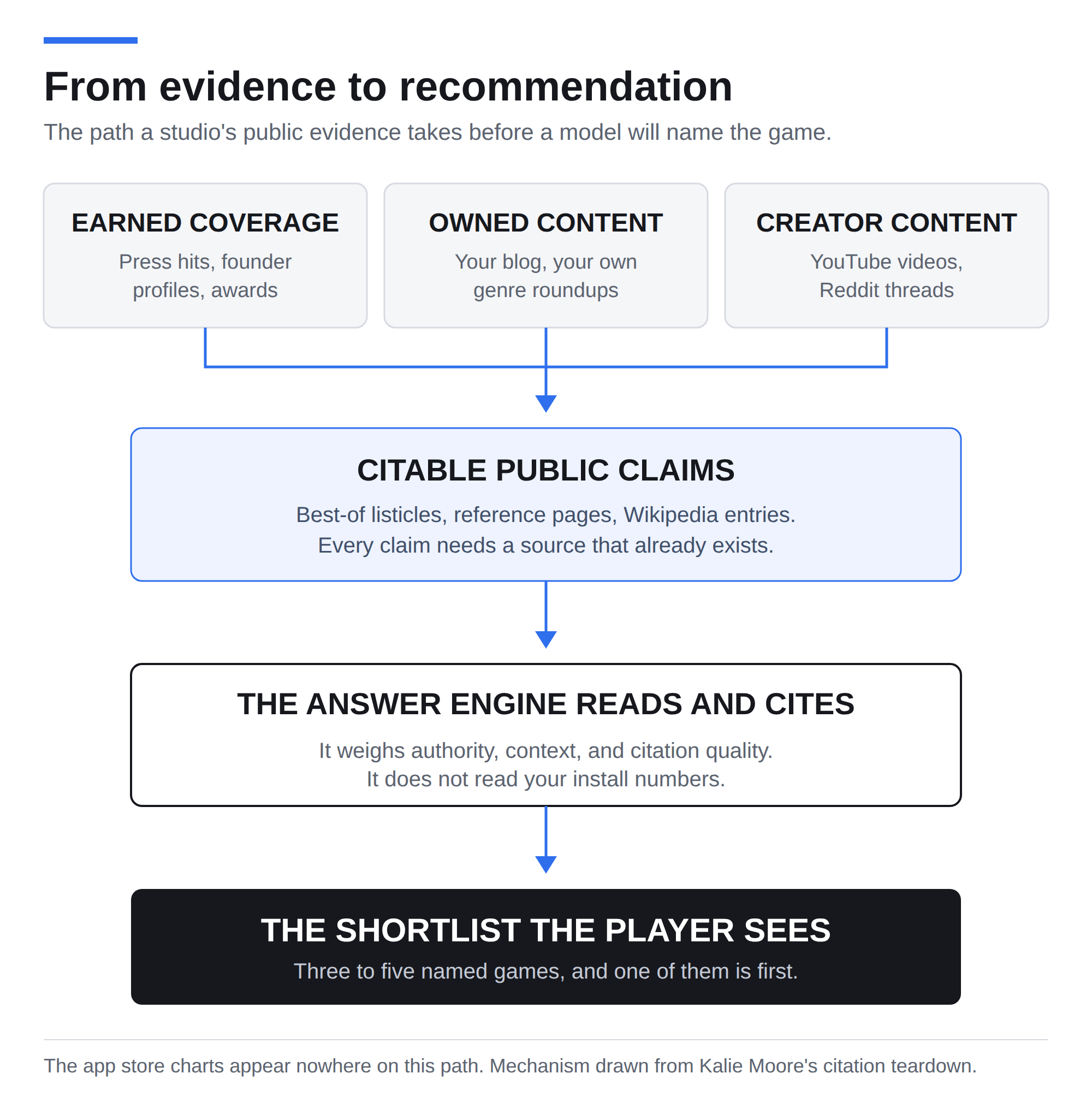
“App stores measure popularity, but LLMs measure something completely different,” she said. “It’s a mix of authority, context, and citation quality.”
Her leaderboard work gets to the same place from the other side. Her team ran prompts across ChatGPT, Gemini, Claude, and Perplexity, three prompts per category, covering RPGs, indie games, cozy, mobile, game studios, and indie studios. They used three prompts each because they wanted the category leader, not a one-off result. Then they cross-referenced everything against Sensor Tower data for both app stores. “The gap is more than I expected,” she told me. There is effectively zero overlap between what the models name and what sits on free or top-grossing, while plenty of paid games do rank.
I pushed on the causal story because I didn't want to walk away thinking the models read the paid chart. “I’m not saying that AI is looking at the paid chart. I don’t think that’s what it does at all,” she said. Her explanation is about the supply of text, and I think it is obviously right once you hear it. “AI names games that are getting press coverage, and those are largely paid games.” Her example makes the point cleanly. “There’s no buyer’s guide for Monopoly Go. There’s nothing to advise on. You simply tap install.” Paid games get buyer’s guides, and buyer’s guides come in exactly the listicle format the models like to cite.
So the ranking is downstream of how much considered writing exists about your game. That is a PR input. It is not a UA input, and I do not think you can buy your way around it.
She can move it, and I asked for the receipts
Plenty of people can describe a system they cannot actually influence, so I asked her for a case where she moved the ranking on purpose.
She gave me Pocket Worlds, the developer behind the mobile virtual world HiRise. HiRise found that many players arrive after aging out of Roblox. So her team built the prompt list around exactly that: best mobile virtual world, best games to make friends, and Roblox alternatives for adults. Roblox dominated all of them at the start, which surprised neither of us. Then they did the GEO work. I had stopped her earlier in the conversation to define GEO for our audience as generative engine optimization. After that work, HiRise outranked Roblox on 10 of 12 prompts in the US, including best mobile virtual world.
Some of those prompts moved inside a month, and I appreciated that she immediately told me why that was possible rather than letting me assume it was the technique. HiRise already had an earned media base to cite. They had creator profiles in Forbes and a Business Insider interview on how the company approaches trust and safety. They had hits in Variety and GamesBeat, and they had won Fast Company’s Most Innovative Gaming award in 2024. That coverage also provided sourcing for a Wikipedia page, where every claim needs a citation. The owned side carried weight too. The blog posts they wrote for those prompts pulled over 350,000 impressions across four months, including over 60,000 on Google’s AI Overview.
She has also run the play on her own agency, which I find more persuasive than any client story, because she had to take the risk herself. She was blunt about the reasoning: she could not sell this to clients without first proving it on her own agency. She had checked it the Friday before we spoke: for best AI PR agency in the US, High Vibe came up number one on Gemini and number three on ChatGPT. She told me the inbound has included a global company she cannot name that found her through Perplexity.
What she could not prove, and why I trust her more for it
I asked whether ranking first actually converts users, and I expected a number. She did not give me one. “Unfortunately, I do not have the absolute best answer for that,” she said, because conversion is genuinely hard for a third-party vendor to track.
What she gave me instead was directional, and she labeled it that way. According to Kalie, AI platforms are pulling 9.5 billion visits a month globally, up 70% year over year, while Google search stays static. Once someone is inside that surface, the published data she cited says AI’s top pick becomes the user’s top pick in 74% of cases. She added that 88% of people accept the shortlist without ever running a second prompt.
That is not a conversion claim, and she did not sell it as one. My own data point: I cannot remember the last time I ran a real Google search. Everything I look up starts with a model now. If your players are anywhere near that behavior, the shortlist is the funnel, and I would rather be early to that than correct about it in two years.
The playbook: four moves on the AI side, two on the comms side
I asked her to get operational and give me the specific things a studio should action. She split her answer into two halves, because she says ranking in the models and running comms complement each other without being the same discipline. I am keeping her split. Four moves on the AI side, then two on the comms side.
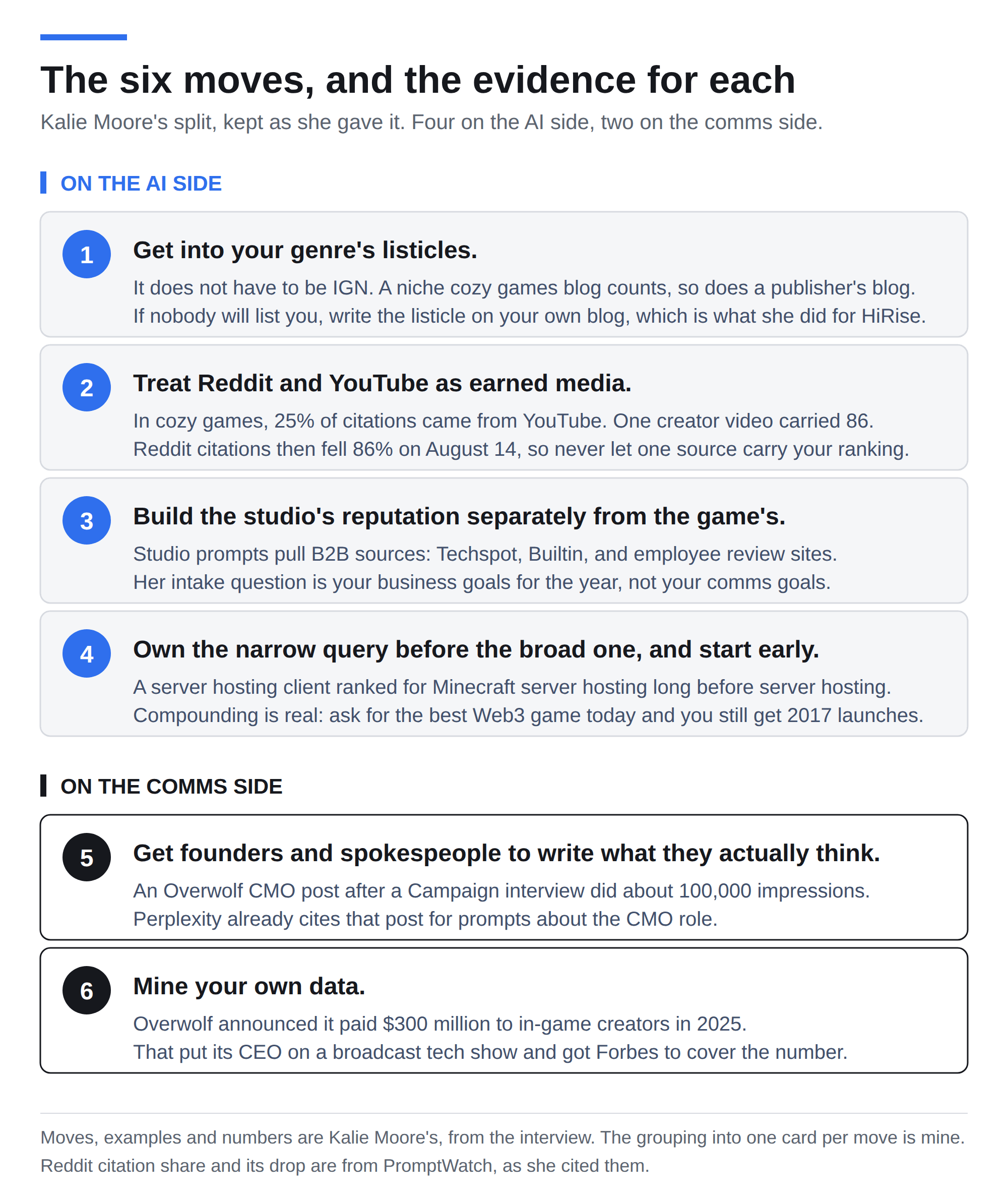
One, get into your genre’s listicles. This is what she calls the lowest-hanging fruit, and she thinks it carries the most impact because listicles are opinionated, well formatted, and easy for the models to digest. The obvious objection is that nobody can just land on an IGN list, and she raised it herself before I could. “It doesn’t have to be IGN,” she said. A niche cozy games blog counts. A publisher’s blog counts. She has watched marketing agency blogs rank for prompts. So find whoever writes the roundups the models cite in your genre. “Reach out like a real person,” she said. “Don’t use AI to generate your outreach. Talk to them and say, this is why we think we should be on the list.” Then invite them to actually play the game. If nobody will list you, she says write the listicle on your own blog, which is what her team did for HiRise.
Two, treat Reddit and YouTube as earned media. Her cozy games data is the whole argument, and it is the number that most surprised me in our conversation. Across that category, 25% of citations came from YouTube. One video from a creator named Sid Mack carried 86 citations, roughly half the citations in the category, and she has 500,000 subscribers rather than five million. “It doesn’t matter what kind of press you’re in if you want your cozy game to rank for best cozy game,” Kalie said. “Creators are a much better route, and this proves it.” She told me she would go straight to a creator like that and ask what an influencer deal looks like. She added a warning I would take seriously. Reddit accounted for almost 4% of ChatGPT search citations, and as of August 14 that dropped by 86%, according to PromptWatch. Her lesson: never let one source carry your ranking, because the models reweight without telling you and the work goes with it.
Three, build the studio’s reputation separately from the game’s. Different questions pull different sources, and I didn't expect them to be so different. For studios and indie studios, she sees far more B2B citations: Techspot, Builtin, and employee review sites, which she flagged as the surprising one herself. Her intake question is not what your comms goals are. It is what your business goals are for the quarter and the year, and then the comms plan is built to serve those. If you are about to hire aggressively, she wants the studio positioned for that, on your own channels and in every podcast your executives do.
Four, own the narrow query before the broad one, and start early. One of her new clients, a server hosting platform, ranked for Minecraft server hosting but not for server hosting generally. She treats that as the correct order rather than a shortfall. “Narrow is actually better to start with. That’s where their audience is.” Then she said the part I think studios will least want to hear. “Compounding, just like with a stock market and retirement, compounding is real.” Ask the models for the best Web3 game today, and you still get Axie Infinity and The Sandbox, launched in 2017 and 2018, because they are sitting on hundreds of thousands of pieces of coverage that a launch this year cannot outrun.
On the comms side, she gave me two, and both come down to who is doing the writing.
Five, get your founders and spokespeople to write down what they actually think. She credits Lulu Cheng Meservey, who ran comms at Activision Blizzard, with coining “founders going direct,” and she thinks it matters most at the early stage. “No one is going to want to tell the story of your vision. How you tell it is yourself.” The payoff here isn't just audience; it is also sourcing. Journalists read LinkedIn, and the models increasingly cite it. Her Overwolf example ran the full loop inside a week. She saw a Campaign Magazine writer working on the evolving CMO role, pitched Overwolf’s CMO, he did the interview, then posted the piece with his own thinking on top. That post did around 100,000 impressions, and Perplexity is already citing it for prompts about the CMO role. Her read, and I agree with it, is that the third-party validation is what made his own thoughts travel.
Six, mine your own data. She thinks most companies are sitting on proprietary numbers that journalists would happily build stories around, and I think that is the most underused asset in games. The Overwolf pattern again: every year they announce what they paid out to in-game creators, and in 2025 that number was $300 million, which put their CEO on a broadcast tech show and got Forbes to cover it. Her filter is the sensible one. What can you share that will not get anyone in trouble?
The one rule she asked me to pass on
She interrupted her own answer to make this point, so I am giving it its own section. “If anyone can take anything away from this episode, do not use AI to write thought leadership,” she said. “You lose everyone.” Her follow-up was even flatter: “It’s better to just not post anything at all.”
I told her about what I call AI masquerading. People strip out the em dashes, or salt in a few typos, so their writing doesn't read as generated. She told me that misses the real problem, and quoted Lulu Cheng Meservey back at me. AI makes everyone average. If you are below average, it lifts you up. If you are above average, it drags you down into the middle, and the flattening happens in the thinking rather than in the cadence.
Her proof is her own posting record. A client handed her a media list clearly generated by a model, including a journalist who had died and others who would never have covered the topic. Cleaning it up cost her more time than building the list from scratch. She was annoyed; she wrote about being annoyed, and that post did around 20,000 views, her highest. “How can you be authentic? How can you be real?”
I will point out what makes this credible rather than convenient. She is the person selling AI ranking services, and she is telling you to keep the models out of the part of the work that matters. I have mostly checked out of LinkedIn myself for exactly the reason she describes, because my feed became one generated post after another and I stopped reading any of it.
What I would do this week
Here is the exercise, and it fits in an afternoon. Write three prompts a player would really type in your genre. Run each one across ChatGPT, Gemini, Perplexity, and Claude, and add “cite your sources” so the models show their work. Log every domain that comes back. That list is your real press target list, and I will bet it looks nothing like the media list you are working from today. Then pick the single narrowest query you could plausibly own and assign one person to earn one citation in it. Rerun the whole set monthly, because the models reweight without warning and you want to see it move.
If you ship games, run three prompts a player would really type in your genre, ask the model to cite its sources, and write down every site that comes back. That is your press target list, and I will bet it looks nothing like the media list you are working from today. If you run a studio rather than a title, run the same exercise on hiring and partnership prompts, because Kalie’s data says those pull from a completely different set of sources.
Then start, even if you feel late. “Just start and chip away at it,” she told me, and given that most of what ranks today was published years ago, I think waiting another quarter is the expensive option.
Kalie is at highvibepr.com. The full conversation, including her walkthrough of the gaming GEO leaderboard, is in the episode.