Here’s the top of the Fortnite metaverse, as of June 20, 2026, during a Saturday night at around 8 pm EDT:
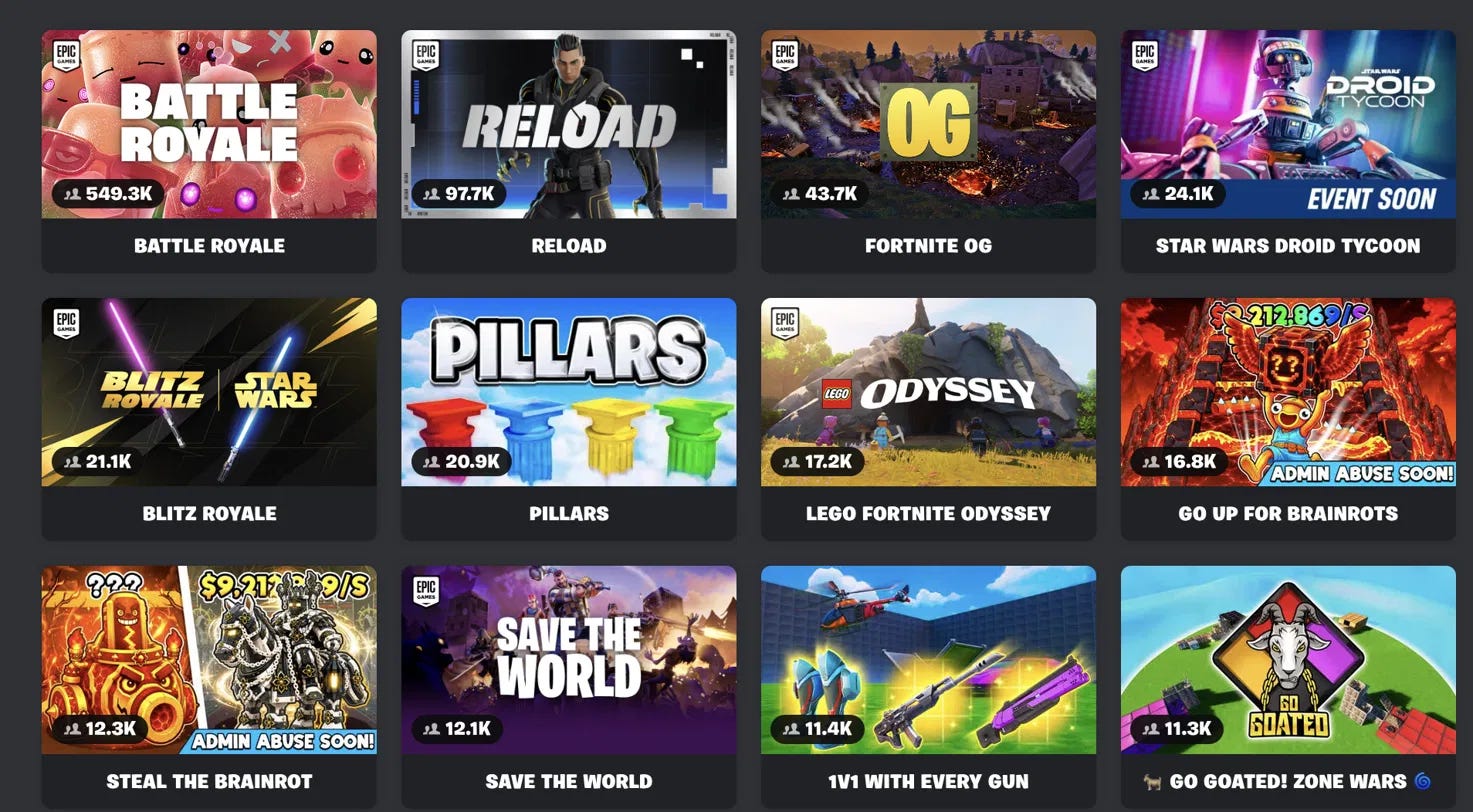
(Source: fortnite.gg)
#1. Battle Royale: 549.3k concurrent players.
#2. A battle royale variant: 97.7k
#3. Another battle royale variant: 43.7k
#4. A Star Wars idle tycoon: 24.1k
#5. Yet another battle royale variant: 21.1k
#6. An arena shooter: 20.9k
#7. LEGO Fortnite Odyssey: 17.2k
#8. A brainrot tycoon: 16.8k
#9. Another brainrot tycoon: 12.3k.
#10. Save the World, the original co-op PvE mode that Fortnite started out as: 12.1k.
#11. An arena shooter: 11.4k.
#12. Another arena shooter: 11.3k.
Combined, Epic’s own non-battle-royale games — LEGO Fortnite Odyssey and Save the World — reach only 55% of the idle tycoons’ combined playerbase. Battle Royale and its variants make up 85% of the top 12’s playerbase.
Worth noting: Fortnite’s all-time concurrent peak was 14,343,880 players — recorded just 1.6 years ago. Current concurrent sits at 1,210,150. The platform that was supposed to become the metaverse is now running at 8.4% of its peak engagement.
If this doesn’t seem like a metaverse to you… that’s because it isn’t.
But this is what the Fortnite metaverse looks like in practice.
This isn’t a discovery problem. It isn’t a tooling problem. And while the economics make it worse — as we’ll see — they aren’t the root either.
It’s an audience problem.
And that problem was decided before UEFN — Epic’s Unreal Editor for Fortnite — ever launched. Before the first island was built, before the first creator-economy policy was written, before the first developer saw a revenue-share agreement.
What Epic is learning, slowly and expensively, is the most important lesson in platform strategy:
You can’t turn a game into a platform just by adding tools.
You can only build a platform if your players arrive wanting one.
I. The Wrong Kind of Crowd
Every platform that works — Roblox, Minecraft, Steam — has something in common that has nothing to do with technology or funding.
Their users arrive to browse.
Not because a single flagship game pulled them in. They arrive with exploration as their default mode. The platform is the product. Whatever they discover inside it is secondary.
This is not how Fortnite’s audience works.
Think of it like a shopping mall. (A modern one, not the social hubs that they used to be at their peak.) Epic built the most popular anchor store in the city — Fortnite Battle Royale, the store everyone comes for. Then they built out the rest: Rocket Racing in one unit, Festival in another, Ballistic down the corridor. The assumption was that foot traffic from the anchor would spill over.
But people who come to this mall don’t come to browse. They come for the anchor store. They walk in, go straight to it, and leave the mall after they’re done playing. People don’t say “I’m going to browse Fortnite.” They say “I’m going to Fortnite Battle Royale.”
Roblox isn’t a mall. It’s a bazaar. No anchor store. Players arrive to wander. That wandering is the product.
This difference isn’t about quality or investment. It’s about why the person on the other side of the screen opened the game in the first place. And that “why” is the hardest thing in platform-building to change — because it was formed long before you decided to become a platform.
Fortnite’s identity was locked in years ago: a battle royale shooter, polished to become one of the most successful games ever made. That identity shaped every player who ever logged in. It shaped what they expected to see, what they were willing to try, and — most importantly — what they would tolerate leaving the main mode for.
There’s an obvious objection here: Fortnite’s audience has left battle royale before, in enormous numbers. The Travis Scott concert in 2020 drew 12.3 million concurrent players. Marshmello, Ariana Grande, the live Star Wars trailer premieres — Fortnite has repeatedly marched millions into experiences that aren’t shooters at all.
But look at what those experiences share. They’re scheduled. They’re social. They last fifteen minutes. And they ask nothing of you but to show up and watch. They are the opposite of a destination you browse to. The concerts don’t disprove the thesis — they sharpen it.
Fortnite’s audience will leave the main mode for a zero-commitment, time-boxed event, and then walk straight back. What it won’t do is treat the surrounding island as a place worth exploring on its own. An event is a detour. A platform needs players to make the detour the destination — and that is exactly the behavior Fortnite never taught them.
The genre numbers on June 20, 2026, tell the story bluntly:
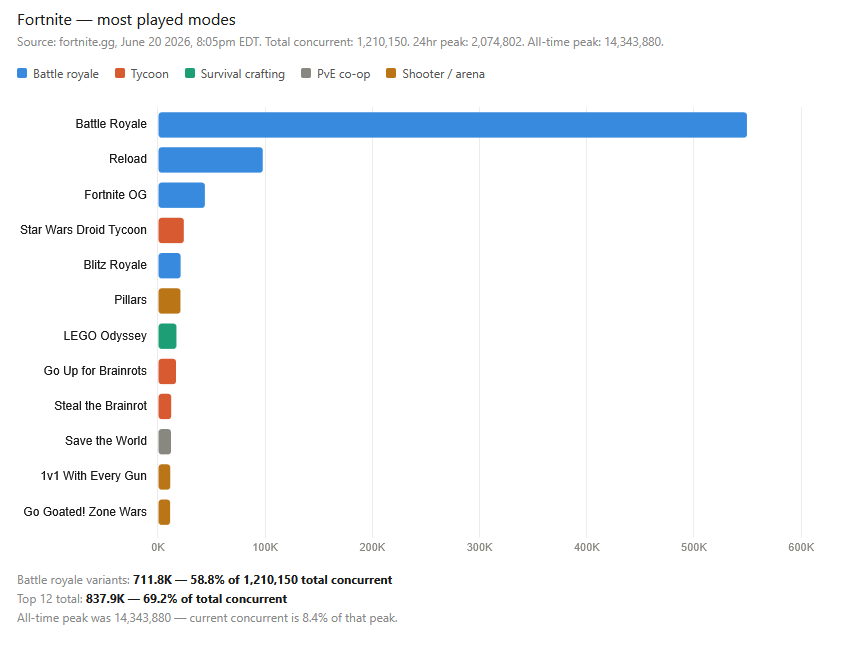
Fortnite top 12 experiences: 5 genres. Based on the total concurrent player count of 1,210,150, over 58% of the player base is in Battle Royale and its variants.
That means all of the non-battle royale games are fighting for that remaining player base of 499k. Outside the top 12, that’s a playerbase of 372k.
Compare this to Roblox:
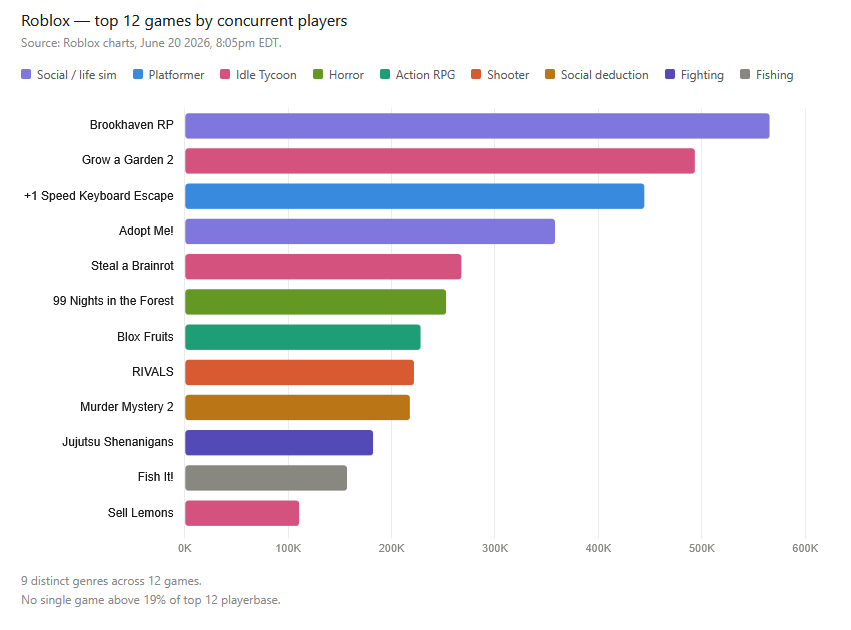
9 genres. With a concurrent player count of 10,713,176, the top 12 games make up just 32.7% of the playerbase — meaning there’s still 7.2 million players up for grabs outside the top 12.
And notice how there’s no real genre dominance. Idle tycoons are popular, but not much more so than anything else.
You might object that this comparison is rigged by scale. Roblox has 10.7 million concurrent players to Fortnite’s 1.2 million, and a near-two-decade head start on conditioning people to browse. Both are true. But scale is the symptom, not the rebuttal. Roblox didn’t become diverse because it got big — it got big because it was diverse from the start, with no anchor experience large enough to define what “playing Roblox” even meant. Normalize for size, and the shape holds: Fortnite funnels more than half its players into a single genre; Roblox spreads them across eight. Epic has more players than almost anyone else, and still can’t move them three feet to the left.
Just imagine any other big-name game doing what Fortnite did, and you’ll quickly see how absurd this experiment was. Would you make shooters in Mario Kart? Play a social sim in Call of Duty? Browse for rhythm games in EA Sports FC?
This is the fundamental tension at the heart of UEFN: when your platform is defined by one game, every other experience competes with that game for the same players. And the only way to win that competition is to be just as compelling as the game that brought players in the first place.
II. Epic’s Failure to Expand Their Audience
Fortnite built stores in their mall that weren’t as nice as the original store — and for an audience that only came for that store, almost nothing else was ever going to be enough.
Nintendo players try unfamiliar genres because Nintendo spent decades establishing that anything with its name on it will be exceptional. The quality isn’t a bonus — it’s the mechanism by which trust is stored and withdrawn. Mario Kart succeeds because it is the best kart racer ever made, not because it sits next to Pokémon on a storefront.
Valve achieved something even harder. Portal should not have worked. Valve’s audience was a shooter audience. Portal had no competitive multiplayer, no progression systems, no traditional combat — just physics puzzles narrated by a homicidal AI. But Valve shipped it in The Orange Box, which bundled it with Half-Life 2 and Team Fortress 2, forcing it on an audience that hadn’t asked for it. Because the trust was already there, the players followed. Portal became one of the most beloved games ever made not despite coming from a shooter company, but because Valve had banked enough goodwill that audiences were willing to go somewhere unfamiliar.
That is what Epic needed from UEFN’s first-party slate. Instead, they produced Rocket Racing, Festival Battle Stage, and Ballistic.
Rocket Racing competed against Forza and Rocket League without surpassing either. Festival Battle Stage stripped the fantasy structure that made Guitar Hero compelling and added a broken competitive mode where higher difficulty players were paired against lower difficulty ones — meaning the former always won simply by having more notes. Ballistic entered a market dominated by Counter-Strike and Valorant without a meaningful reason to switch. Festival and Ballistic were cut in April 2026. Rocket Racing follows in October.
The issue was not merely that these games underperformed. First-party content establishes the creative ceiling of a platform — and when Battle Royale exists as the benchmark, players immediately know when something hasn’t received the same care. In the age of infinitely expanding game libraries, just throwing out a couple of MVPs isn’t going to cut it.
The PUBG comparison makes this hard to excuse: Epic took someone else’s formula, refined it obsessively, and made the defining game of a genre. They know how to take something seriously. They just chose not to apply that standard here.
The one partial exception is LEGO Fortnite Odyssey at 17.2k concurrent players — and it earned that by not asking players to switch cognitive models. Survival crafting overlaps psychologically with progression-driven players, and the LEGO aesthetic sidesteps Fortnite’s visual standard. But survival crafting shares significant DNA with the idle tycoon format — incremental progression, resource accumulation, long sessions. Odyssey's resilience may reflect the engagement metric as much as genuine player investment.
You can’t expect third-party developers to make up for these shortcomings — and as the next section shows, the platform gave them little reason to try.
III. Why Third-Party Developers Were Set Up to Fail: Economics
The audience problem doesn’t act alone. It’s compounded by an economic structure that actively rewards the blandest possible use of the platform.
Here’s a sneak peek at the games just sitting outside of Fortnite’s top 12:
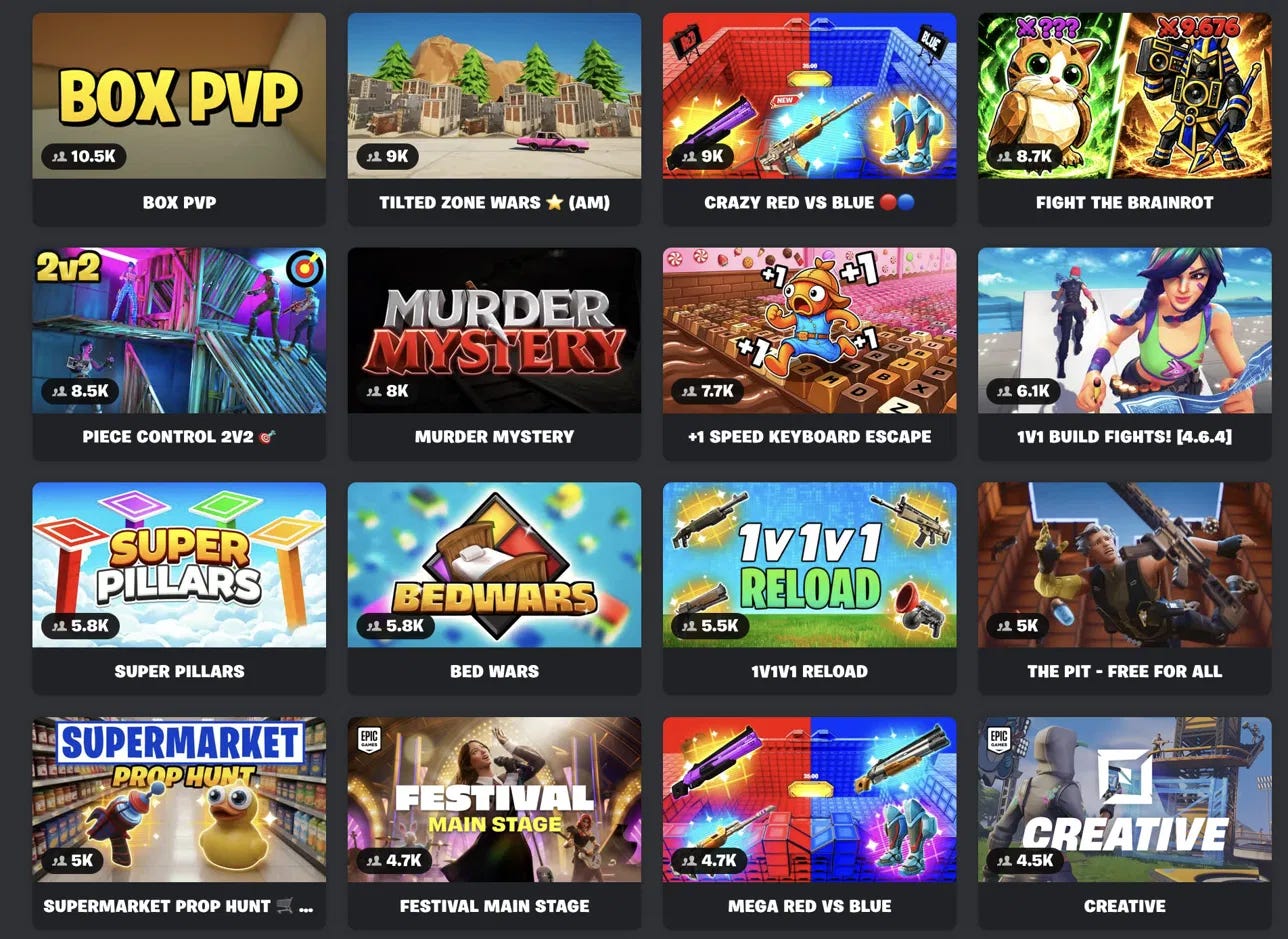
Outside of Fortnite Festival Main Stage, Fortnite Creative, the idle games (Fight the Brainrot and +1 Speed Keyboard Escape), and two social experiences (Murder Mystery and Supermarket Prop Hunt), every game here is an arena shooter.
Given that Battle Royale is a shooter, it shouldn’t be a surprise that the other popular modes are shooters too. What’s surprising is how derivative they are: a “Pillar” game (vertical build-and-fight arena) that we already saw in the top 12, two “Red vs Blue” team shooters, and the rest variations of PvP combat.
The reason is the engagement payout structure. 40% of Fortnite’s Item Shop revenue is distributed to developers based on engagement. That system incentivizes games with low commitment and repeatable loops — experiences that generate maximum session time with relatively little development effort. It’s made worse by the fact that players can earn battle pass XP from playtime in third-party islands, so Battle Royale players are just using these games to grind XP rather than looking for interesting experiences.
Hence why idle tycoons and arena shooters dominate even the second tier, beating out Epic-made experiences like Festival in the process.
Epic has tried to fix this with better developer economics — in-app purchases, limited-time revshare bonuses, a billion-dollar legal battle against Apple and Google over the 30% platform fee on mobile. But better margins don’t create an audience. They just give you more ways to extract value from the one that’s already there.
And that audience is smaller than it looks. As mentioned previously, a third-party UEFN developer is facing a market of 372k players if they’re outside the top 12. Roblox developers have 7.2 million players available outside their top 12 alone.
There’s no economic incentive for developers to try to help change that — as doing so would require marketing outside Fortnite entirely, because the players who would want a genuinely new experience aren’t already in the ecosystem to begin with. Why would someone who has never played Fortnite download 100GB just to try an indie game buried inside it? They wouldn’t. They’d rather play it on Roblox or find it on Steam instead.
More players, of course, means more revenue. So while Epic celebrated $1 billion paid to UEFN creators at State of Unreal in June 2026, Roblox paid $1.5 billion to creators in 2025 alone.
One thing to note is that Fortnite returning to the App Store and Google Play means mobile playtime in developer-made games has more than doubled in the past year. This is real progress on one of UEFN’s key disadvantages versus Roblox. A Fortnite player on mobile is still a Fortnite player — they came for battle royale — but the distribution handicap is narrowing. It doesn’t solve the audience problem.
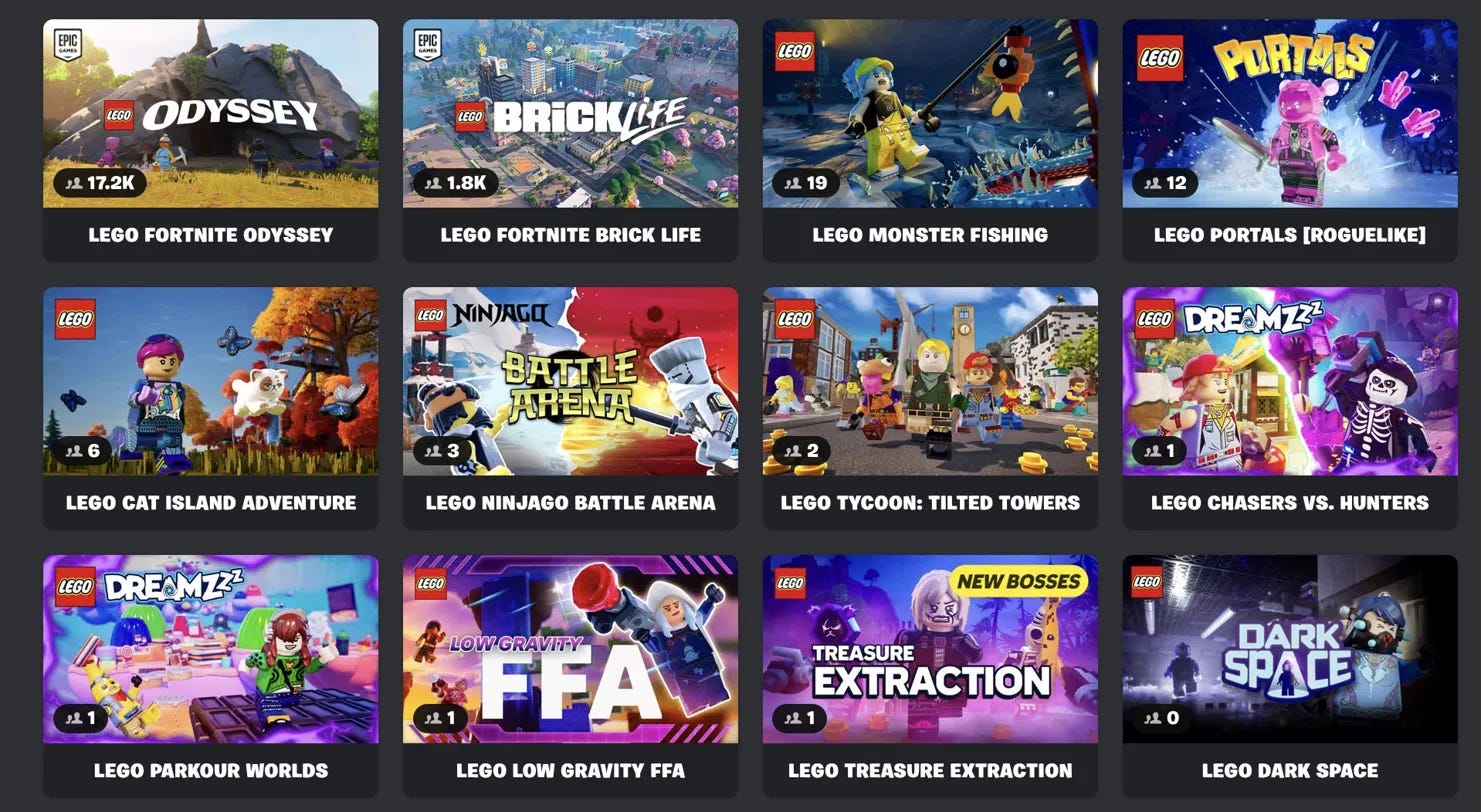
Epic has leaned on brand collaborations to try and bring in new audiences, but they haven’t helped developers either. LEGO experiences carry worse economics — the LEGO Group takes 15% of every island payout on top of Epic’s baseline, and the forced E10+ rating limits what can be built. And none of the LEGO experiences have drawn a meaningful player base outside LEGO Fortnite Odyssey.
A quick search of “lego” on fortnite.gg shows playerbases in the single digits for non-Epic-produced games:
It’s the same story with the other brands. K-Pop Demon Hunters is the sharpest illustration. The Netflix animated film holds the record for the most-watched movie in Netflix history, with 537 million views, and its fanbase skews overwhelmingly female. Fortnite’s audience is roughly 72% male and came for a competitive shooter.
Here’s the status of those K-Pop games:
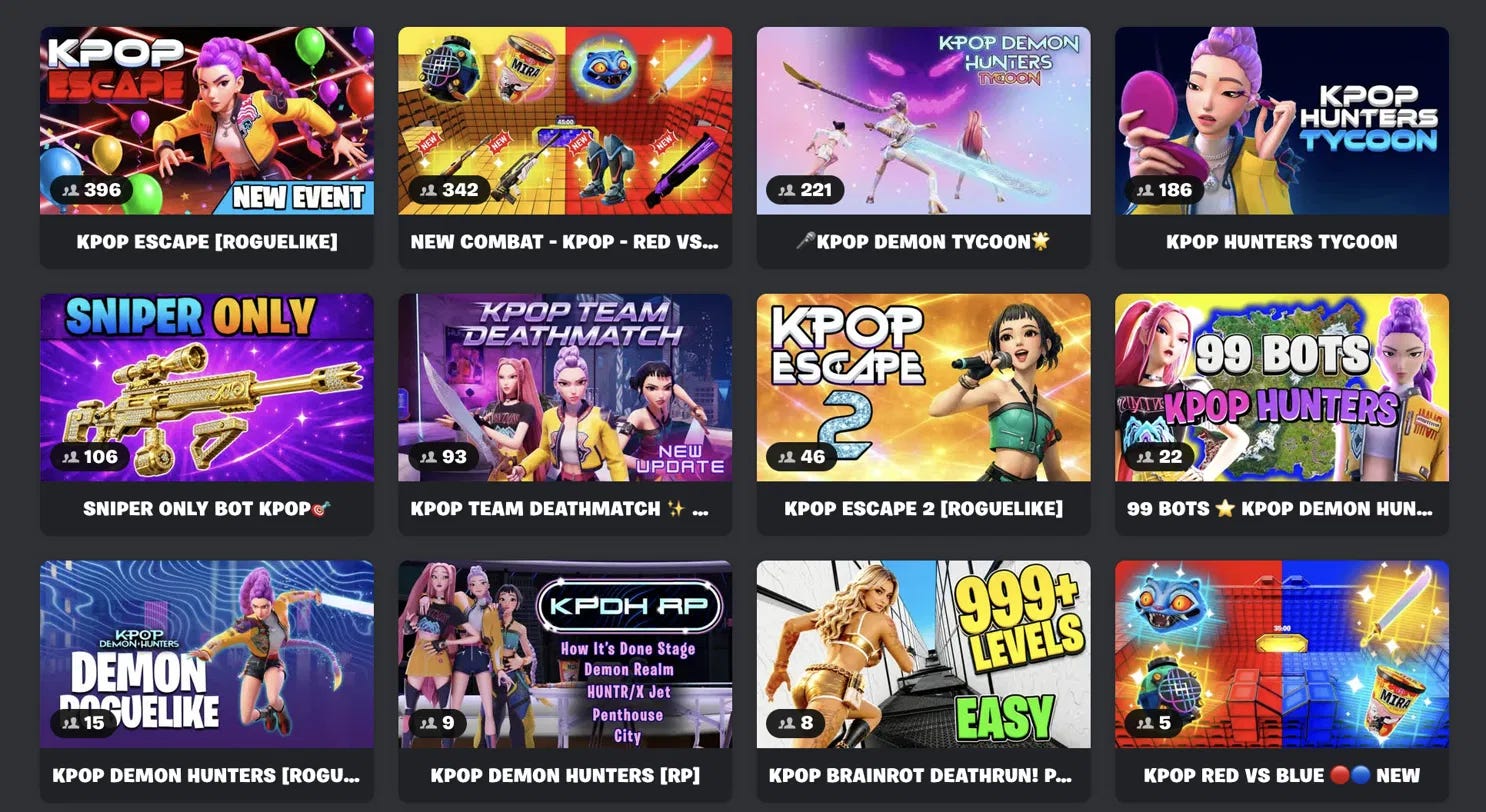
If a 537 million-view-strong fanbase couldn’t build a lasting bridge, neither can Squid Game, Teenage Mutant Ninja Turtles, or The Walking Dead. They failed to draw in the fans of those IPs to make any lasting impact worth it for developers.
And it’ll most likely be the same story when they add The Simpsons this fall. Even though The Simpsons mini-season in Battle Royale was successful (2.7 million concurrent players strong) - remember that players enjoyed The Simpsons within the context of Battle Royale.
The Star Wars games show all of this in action. Epic had access to one of the most powerful entertainment IPs in the world, Disney’s endorsement, professional studios, and the resources to build across multiple genres. It chased trends instead: a “friendslop” experience (Escape Vader), a Battlefront-inspired shooter (Galactic Siege), and an idle tycoon (Droid Tycoon).
Escape Vader: 123 concurrent players as of June 20, 2026. Galactic Siege — the most ambitious, highest-production Star Wars project on the platform — settled around 599 despite the investment.
Droid Tycoon: 24.1k.
At State of Unreal 2026 — Epic’s flagship developer conference — the exemplary UEFN success story chosen for the main stage was Star Wars Droid Tycoon. Not the Battlefront-inspired shooter with higher production values. Not the social experience. The idle tycoon.
Epic’s own curation of what UEFN success looks like confirmed everything the player counts already showed.
IV. Why Third-Party Developers Were Set Up to Fail: Aesthetics
There’s a second structural problem, less discussed but equally important, that compounds everything above.
Roblox didn’t arrive at its low-fi visual identity by accident. It committed to it deliberately, and held that commitment even as Minecraft proved a more polished low-fi aesthetic could find massive audiences. That commitment sets the visual floor low enough that any developer can publish without looking out of place. Players arrive with no visual expectations. Rough edges become part of the identity, not marks against it.
Fortnite’s aesthetic standard is Fortnite Battle Royale — one of the most visually refined live-service games ever made. Clearing that bar takes real resources most developers don’t have. And when they try and fall short, their games don’t just look rough inside UEFN. They look wrong.
Fortnite’s problem is structural: you can’t make Fortnite look worse to lower the bar for developers, and you can’t make third-party games look as good as Fortnite without at least AA budgets. The platform is trapped in the middle — which is why Epic is being forced to hand developers premade assets.
Epic has tried to address this two ways, with limited success.
LEGO Islands give developers a visual framework that doesn’t get measured against Fortnite’s standard — but, as noted, the economics are worse once the LEGO Group’s cut is factored in, and players aren’t flocking to LEGO experiences anyway.
In November 2025, Epic and Unity announced a partnership that will let Unity developers publish in Fortnite starting in 2026, removing engine lock-in and aesthetic constraints at once. On paper, it’s the most significant structural change since UEFN launched. Unity removes the technical barrier.
But it doesn’t touch the audience problem. A Unity-built dungeon crawler can now, in theory, publish inside Fortnite — but it’s unlikely Fortnite’s players will go for a dungeon crawler divorced from the main game. The burden’s still on the developer to convince prospective players to come check out Fortnite in the first place.
Better tools don’t condition players to explore.
V. Two Honest Paths
Epic announced a full Discover redesign at State of Unreal — video throughout, deeper personalization, social signals on tiles, Discover replacing the lobby as the first thing players see when they open Fortnite.
It’s a meaningful improvement to a real problem. But discovery isn’t the core problem. If players arrived wanting to explore, better discovery would help. Fortnite players arrive for Battle Royale. Making the lobby show them Discover first doesn’t change why they opened the app. You can’t fix an audience problem with a UI change. If anything, it’ll just annoy your core audience even more.
The standard fixes proposed for UEFN — better discovery, improved creator economics, lower barriers — are all necessary. Without them, the platform fails faster. But none of them solve the core problem because it is not technical.
There are two honest paths forward.
Option One: Build a new platform entirely.
Spin UEFN out from Fortnite‘s gravitational pull. A new platform with a simpler default art style, no anchor store monopolizing half of all attention before any creator game is even seen, and a player base that arrives with no pre-existing expectations. Creators compete on neutral ground.
The hard question: how do you build a browse-native audience from zero?
Roblox didn’t happen overnight. It spent nearly two decades conditioning players to explore before the platform became what it is today. Minecraft's community emerged because the game’s identity was literally openness — the product and the platform were the same thing from day one.
This is possible. But it is not fast, not cheap, and not guaranteed. Hell, Roblox is still reporting operating losses to this day.
Option Two: Accept what the product actually is.
Narrow the vision toward what the community demonstrably wants: shooter-adjacent experiences, survival crafting, simple progression loops. Acknowledge that UEFN has become — and may always have been destined to become — just a fancy editor attached to a battle royale game.
This is not a small ambition dressed in defeat. It is a coherent and defensible product. If Fortnite became the best shooter-adjacent creator platform in the world, that would be a real and valuable position.
There is even a path to grow from it: treat UEFN as an incubator, with the best experiences graduating to the Epic Games Store as standalone titles — where developers can keep their IP, take better revenue terms (100% on the first million, 88% after), and reach a new audience.
UEFN as a proving ground. EGS as destination. That’s a story developers could believe in.
Both options are more coherent than the current path: a platform still rhetorically chasing the metaverse while structurally rewarding passive engagement farming, and hoping nobody notices the gap between the vision and the reality.
What This Means If You’re Building on a Platform
If you’re a developer considering UEFN — or any platform — the honest summary is this:
Pay less attention to the tools and more to the audience. A platform can have the best engine, the most generous revshare, and the biggest marketing budget. What it cannot manufacture is a community of players who arrived to discover something new.
That community is either there or it isn’t. And the signs are usually visible early. Does the platform have a flagship product that defines it? Is player behavior destination-driven or exploration-driven? Do the top experiences cluster in a single genre, or spread across many? Does the payment model reward retention, or design quality?
The answers tell you more about your prospects than any feature roadmap.
If you’re building on Fortnite specifically, the structural conditions favor one kind of experience: low-friction, passive, short-session, adjacent to what players were already doing. The engagement payout rewards retention behavior. The audience arrived for battle royale. The aesthetic standard prices out most third-party work unless you use LEGO (worse economics, known audience problem) or wait for Unity integration (unknown economics, known audience problem). The top charts make plain what performs.
And it must be noted that Roblox also favors these types of experiences. So does Steam.
None of this makes success impossible. It means the game you’re building has to account for the platform’s gravity, not fight it.
Conclusion: You Can’t Force a Community
Epic built one of the most successful games ever made. Then it mistook that success for permission to become a platform.
There’s a useful quote from Adam Miller, former VP of Engineering at Roblox, on the discipline the platform required when Minecraft arrived and blew past them in growth:
“When Minecraft arrived, with a very similar audience, it just blew through Roblox. It took some fortitude to not just copy Minecraft and say that’s more of a game, we should be more of a game.”
By not tying the platform too closely to a single game, Roblox avoided being locked into one playerbase’s expectations. Epic had no such separation. Fortnite’s identity was fixed before UEFN existed, and everything built on top of it inherited that identity whether Epic intended it or not.
The alternative is the hard way: build games so consistently excellent that players eventually trust you enough to follow you somewhere new — the Nintendo and Valve model. But that takes decades, costs hundreds of millions in first-party development, and still requires a player base conditioned to explore. It’s a high bar for a platform designed primarily to profit from third-party work.
Epic tried to accelerate the process with scale, technology, and IP. But the LEGO, K-Pop Demon Hunters, and Star Wars fanbases aren’t playing the metaverse experiences built for them.
Meta tried the same acceleration with Horizon Worlds: it dangled Batman and Among Us in front of Facebook and Instagram users, spent billions, and ended with a VR metaverse that shut down on June 15, 2026 — never reaching more than a couple hundred thousand users. Roblox, meanwhile, boasts 10.7 million concurrent players.
The failure mode is the same whenever a company with an existing audience tries to will a platform into existence. The assets are real. The technology is real. The audience is real. What is not automatically real — and cannot be purchased or engineered into existence — is the reason those players arrived in the first place.
Epic’s players arrived to play Battle Royale. Three years and millions of dollars later, most of them still are.
The metaverse wasn’t killed by bad tools or greedy economics.
It was killed by a truth no amount of investment can change: your players are not coming for the platform. They are coming for what drew them in the first place. And if that’s a game, then that is what you have — a game, not a platform.
So this is how the metaverse dies. With Star Wars tycoons.
Additional discussion with Ted here:

Ted Park is a Product Consultant who has obviously played too much Fortnite, and now he thinks he’s in with the zoomers. Before writing long-winded articles, he ran an independent game studio that released At Sundown: Shots in the Dark on Steam and consoles.
You can reach him on LinkedIn (linkedin.com/in/theohpark) or by email (ted@mildbeast.com).