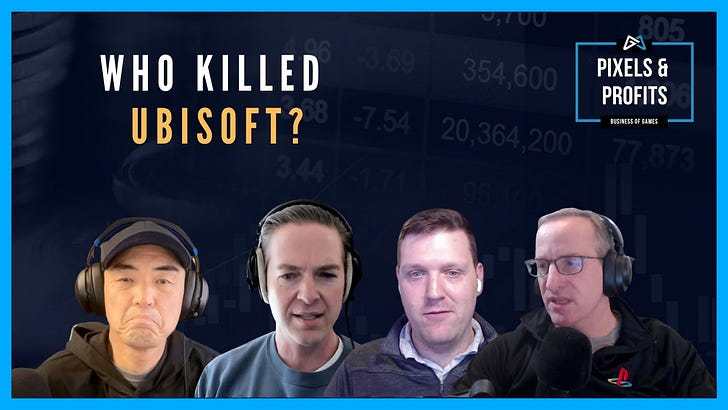

Five years ago, Ubisoft was worth $16.5 billion. Today, the company trades under $1 billion—a 90%+ collapse in market value. But here’s what makes this story worth unpacking: revenue only dropped 20% over the same period.
The disconnect between fundamentals and valuation tells you everything about what’s really broken at Ubisoft. Public markets aren’t pricing in a business downturn. They’re pricing in a complete loss of confidence in the company's leadership.
🎧 Listen on Spotify, Apple Podcasts, or Anchor
Speakers:
Matthew Kanterman, Blue River Financial Group
Joseph Kim, Lila Games
Eric Kress, Deconstructor of Fun
Brian Peganoff, Timber Advisors
The Efficiency Gap That Explains Everything
Matthew dropped a stat in our discussion that crystallizes Ubisoft’s problem better than any other: revenue per employee (we warned you about this 2.5 years ago).
Ubisoft generates approximately $123,000 in bookings per employee. EA generates over $500,000. Take-Two exceeds $400,000 (and in a GTA year, that number climbs even higher).
That’s not a gap. That’s a chasm. And it explains why a company generating $1.85 billion in annual bookings can trade at a market cap barely over $1 billion while EA is selling to Saudi investors for $55 billion.
The story gets worse when you dig into Ubisoft’s recent cost-cutting. From March 2023 to March 2025, they eliminated 3,000 employees and cut fixed expenses by €205 million. They’re planning another €100 million in cuts (roughly 1,500 more people) by March 2027. Despite all this surgery, they’re still projecting break-even operating profit.
The business isn’t generating returns. It’s just surviving.
The Tencent Deal: Lifeline or Exit Strategy?
In November, Tencent invested €1.16 billion (~$1.25 billion) to acquire a 26.32% stake in a new subsidiary, Vantage Studios. This carve-out contains Ubisoft’s crown jewels: Assassin’s Creed, Far Cry, and the Tom Clancy brands (including Rainbow Six).
Brian’s framing of this deal was blunt: “Your company is worth a billion dollars. You’re looking at this rich Chinese investor and saying, ‘You can have my whole company for a billion dollars.’ Instead, they say, ‘How about I just give you a billion dollars for 25% of your three biggest franchises?’ And they shake hands. This only ends one way.”
The deal terms tell the story:
Ubisoft must retain a majority stake in Vantage for at least two years
Tencent has a five-year lockup, while Ubisoft maintains the majority
Roughly 25% of the cash went to paying down debt
This isn’t a turnaround investment. It’s a call option. Tencent gets exposure to franchises that have generated $9.5+ billion over the last decade, with minimal downside risk. If the Guillemot family continues to mismanage these IPs, Tencent can wait and potentially acquire the rest at distressed prices.
Matthew suggested an alternative endgame: “What’s more likely to me than Tencent buying it out is in two years they flip Vantage to private equity. They sell Vantage to private equity and leave Ubisoft shareholders holding the bag on everything else.”
How Did Europe’s Gaming Champion Implode?
Three structural failures destroyed Ubisoft’s position.
First: The Copy-Paste Design Philosophy
Starting in the 2010s, Ubisoft perfected open-world game design. The problem? They applied the same template to Assassin’s Creed, Far Cry, Watch Dogs, and Ghost Recon without meaningful iteration. What worked well for years eventually became a liability as players grew fatigued with the formula.
Assassin’s Creed Valhalla (2020) was actually the franchise’s best-selling entry. The RPG-style pivot in Odyssey and Valhalla worked commercially, even if longtime fans complained the games didn’t feel like “real” Assassin’s Creed anymore. But Ubisoft couldn’t sustain the momentum. And critically, they never built a third Assassin’s Creed studio to maintain an annual release cadence—something Matthew flagged as an inexplicable strategic failure.
Second: Death by a Thousand Pet Projects
Eric's list of misallocated capital is damning: The Crew, Starlink (Toys to Life, launched years after the category died), Rocksmith (which Eric acknowledged was "a great product" but "the juice wasn't worth the squeeze" for profitability), Haze, Avatar, the Quartz NFT platform, XDefiant, and Skull & Bones.
Skull & Bones deserves special mention. An 11-year development cycle. Estimates between $500 million and $1 billion in total investment. The project grew from a minigame in Assassin’s Creed Black Flag—boats were fun, so Ubisoft decided to spin off an entire game. Meanwhile, Xbox launched Sea of Thieves and captured the exact market Skull & Bones was chasing.
Star Wars Outlaws adds to the destruction. The game’s mechanics were solid, but design decisions alienated the target audience. It sold roughly 1 million units—disastrous for a AAA Star Wars title, given whatever minimum guarantee Ubisoft paid Disney.
Eric’s indictment: “EA, all the other publishers were focusing on three or four big franchises and doing a few risky bets. These guys were taking risky bets all over the place.”
Third: Management and Culture
This is where the conversation got uncomfortable.
Serge Hascoët, Ubisoft’s Chief Creative Officer and the creative force behind Assassin’s Creed, Ghost Recon, and Far Cry, resigned in 2020 amid sexual harassment scandals. Three executives ultimately received suspended sentences—Hascoët (18 months), former VP Editorial Thomas François (3 years), and former game director Guillaume Patrux (12 months). The culture Eric described was “endemic.”
But Hascoët’s departure created a different problem. Yves Guillemot, who Eric describes as “not a design person,” took over creative direction for the company’s biggest franchises. Family members—including Yves’s son Charlie, now co-CEO of Vantage Studios overseeing Assassin’s Creed, Far Cry, and Rainbow Six—have proliferated through leadership positions.
The departure of Yannis Mallat (Managing Director of Ubisoft’s Canadian studios) and Cécile Cornet (Global HR) in 2020 marked the end of objective management outside the family. Since then, every major decision has been made by the Guillemot family members and their loyalists.
Eric’s assessment: “This whole thing was set up so they could maintain the family. Yves has always wanted his family to inherit this company. And this is what this Tencent deal gave him—that security. But it’s definitely not good for the franchises, certainly not good for the shareholders.”
The France Problem
One structural challenge Ubisoft cannot solve: 25% of its workforce (roughly 4,000 people) is based in France, where labor laws make headcount reductions extraordinarily difficult.
Eric’s provocation: “If you actually shut down Paris, if you shut down all operations in France, you would lose almost no value to this company. They literally have no development and no management required to manage their biggest franchises in France.”
All of Ubisoft’s valuable IP development happens in Canada. The Tencent deal essentially creates a path where “Canada will be Ubisoft and France will just basically get shut down.”
The Only Bull Case
Is there any path to recovery?
There is likely great talent within Ubisoft studios. Eric emphasized that the development teams—particularly in Montreal—are capable of making great games. The Division team is excellent. The Assassin’s Creed team has delivered when given proper direction.
According to Eric, the problem isn’t the people making games. It’s the decisions being made above them.
Clair Obscur: Expedition 33, the critically acclaimed RPG from Sandfall Interactive, was led by a former Ubisoft producer who left the company. The talent likely exists. The question is whether it can express itself under the current leadership.
Rainbow Six Siege proved that Ubisoft could build and operate a genuine live service success. That template exists—they just never replicated it.
But our collective view was pessimistic. The company remains under the same management that destroyed over $15 billion in shareholder value. The Tencent deal provides runway, but it also reveals how limited outside confidence in a recovery truly is.
Brian summarized what public markets have already concluded: “This is not a mystery to anybody anymore. This company is using this as a slush fund for the family to operate and do a terrible job, and they don’t give a shit anymore.”
Key Takeaways
Ubisoft’s revenue per employee ($123K) is 4x lower than EA’s ($500K+)—this efficiency gap explains the valuation collapse better than any single failure
70% of Ubisoft’s bookings come from back catalog titles—they’re living off past hits, not building new franchises
The Tencent deal is a call option, not a rescue—€1.16B (~$1.25B) for 26% of the company’s best IPs is positioned as a put, not a bet on recovery
All valuable IP development happens in Canada—the French operations contribute minimal value while employing 25% of the headcount
Serge Hascoët's 2020 departure removed the creative brain—Yves and family members have made design decisions since, with catastrophic results
The talent is still there—studios like Montreal can make great games under the right leadership; the problem sits at the executive level
What’s your take on Ubisoft’s future? Can the company recover under current management, or is the Tencent deal just the beginning of the end? Leave a comment below.