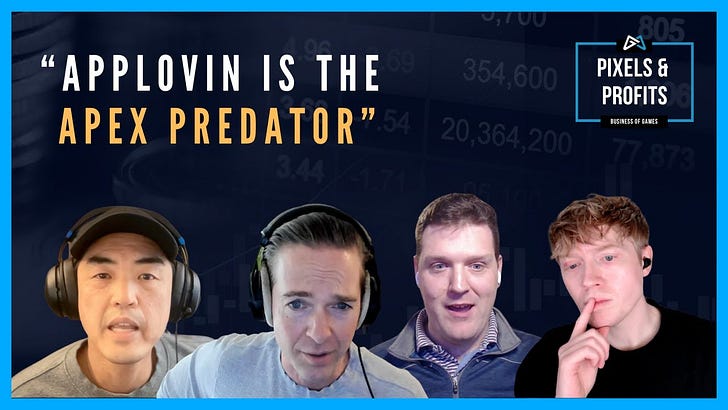

AppLovin is the apex predator in mobile right now. My business is proof that they’re not being prohibitively high in their pricing—because if they were, I wouldn’t be succeeding. But we do lack independence, and it does come across as though we are operating inside somebody else’s system.
That’s Josh Chandley, CEO of WildCard Games and one of the sharpest operators in mobile monetization, describing the uncomfortable reality of building games in AppLovin’s ecosystem. His portfolio generates millions in revenue through AppLovin’s platform—and he’s still nervous about what comes next.
The gaming industry’s most controversial company just crossed $250 billion in market cap. The stock is up 127% year-to-date. EBITDA margins hit 82% last quarter. And yet many executives and investors in the mobile and gaming industry ask the same question: Is this the beginning, or the end?
I assembled what may be the most qualified panel possible to answer that question: Chandley with his hands-on operational data, Matthew Kanterman with a financial analyst lens, and Brian Peganoff with an institutional investor perspective. What emerged wasn’t the typical bull-bear debate—it was a blueprint for understanding how dominance actually works in ad tech.
🎧 Listen on Spotify, Apple Podcasts, or Anchor
Speakers:
Josh Chandley, President & CEO at WildCard Games
Matthew Kanterman, Director of Research at Blue River Financial Group
Brian Peganoff, Former TMT Investor, Founder Timber Advisors
Joseph Kim, CEO at Lila Games
The Numbers Tell One Story. The Operators Tell Another.
AppLovin’s financials look like a typo. Revenue and EBITDA are up 72% through the first three quarters of 2025. The stock trades at 32x forward revenue and 39x forward EBITDA. At a PEG ratio of approximately 1, the valuation is technically justified by projected 2026 revenue growth of 35-40% and EBITDA growth of 40%.
“It’s been a loser’s bet basically for the last three years to bet against Adam,” Kanterman notes. “The valuation has re-rated. The question is what’s next.”
But here’s what the financials don’t capture: the structural lock-in that makes AppLovin’s margins possible in the first place. Chandley laid out the mechanics with uncomfortable specificity.
AppLovin owns MAX, the dominant ad mediation platform. They charge competing networks a 5% fee to bid on inventory—while exempting themselves. “They don’t have to be as good as Meta or Unity,” Chandley explains. “They just have to be 95% as good.” In machine learning-driven auctions where advantages compound at the margin, that’s an insurmountable head start.
The lock-in deepens through Axon, their demand-side platform. For ad-monetized games, it’s completely normal to have over half of your users coming from Axon. And here’s the key: you can only use Axon if you use MAX. Publishers who leave MAX lose access to Axon—and with it, roughly half their user acquisition pipeline.
“That’s why over the last couple of years we’ve seen them able to double their revenue publicly without actually really increasing their share of voice very much,” Chandley says. “Their take rate is just doing incredibly well.”
Translation: AppLovin isn’t growing by winning more auctions. They’re growing by extracting more value from the auctions they already win.
The E-Commerce Expansion: Where the Real Action Is
The bull case for AppLovin increasingly rests on its expansion into e-commerce advertising. Chandley’s data from his own portfolio is striking: at one point on iOS, all 10 of the top creatives in his games were AppLovin e-commerce ads. Around Black Friday, AppLovin passed Google Ads on Android for e-commerce—on Google’s home turf.
“Most importantly for their stock, that dominance—the share of voice, the number of impressions that AppLovin is winning as a percentage—is barely changing despite all of this new demand flowing in,” Chandley explains.
Think about what that means. E-commerce advertisers are flooding in, willing to pay premium prices. But AppLovin isn’t passing that value to publishers. The gap between what advertisers pay and what publishers receive is widening—and that gap is pure margin.
The structural advantages that made AppLovin dominant in gaming translate directly to e-commerce. Their rewarded video inventory is fundamentally different from Meta’s feed ads. “An ad on AppLovin’s rewarded video is a 30-second infomercial,” Chandley notes. “The attention is guaranteed.” That matters enormously for e-commerce conversion.
Meta and Google face three barriers to competing effectively in this space. First, iOS: AppLovin’s share of voice is 30% on Android but 55-60% on iOS. ATT gifted them that position, and five years later, Meta and Google still haven’t recovered. Second, creative relevance: 15-second thumb-stopping content optimized for social feeds doesn’t perform as well in 30-second captive-audience slots. Third, organizational DNA: Meta and Google built trillion-dollar businesses on first-party data within walled gardens. Their entire infrastructure—ML models, sales organizations, account management—struggles outside their owned-and-operated properties.
“Google and Meta are fighting distracted giants in a venue where those giants can’t really use their greatest strengths,” Chandley summarizes.
The Bear Case: Expectations Already Assume Victory
Brian Peganoff frames the bear case precisely: “It’s not like this is a broken company with some hidden structural flaw. The bear case comes down to the valuation already reflecting success.”
At a $250 billion market cap, the stock isn’t expensive given the stretched multiple. It’s expensive because earnings already assume a lot goes right. The risk is disappointment, not multiple compression.
Peganoff identifies five specific concerns. Growth durability—upside depends on self-serve adoption, Axon performance gains, and advertiser wallet share continuing to compound. If that flywheel slows even modestly, operating leverage flips from tailwind to limiter. Expansion optionality—e-commerce and connected TV are attractive but not yet scaled or transparent enough to underwrite as core drivers. Scale effects—the last two years benefited from simplification and low-hanging improvements that become harder to find. Competitive convergence—Google, Meta, Amazon, and Trade Desk don’t need to beat AppLovin; they just need to narrow the gap.
The SEC investigation adds a layer of uncertainty. The agency’s Cyber and Emerging Technologies unit is examining AppLovin’s data collection practices, which were triggered by a whistleblower complaint and amplified by short sellers (Muddy Waters, Fuzzy Panda, Culpert Research). The allegations center on fingerprinting and potentially fraudulent attribution practices.
The panel’s consensus: the risk of deplatforming is real but low. “The likelihood is probably 2-3%,” estimates one panelist. I think it’s higher—maybe 20-30%—but it's still not the most likely outcome. The more likely result is platform restrictions or fines that affect the business model without destroying it.
But there’s a nuance worth considering. “Anytime an ad tech platform shows this kind of performance, people are going to ask where that data access is coming from and could it get shut off,” Peganoff notes. “It’s the whole Cheetah Mobile conundrum.”
The Infrastructure Risk Nobody’s Discussing
Chandley raises what he considers the only significant negative risk: losing control of supply.
Right now, publishers stay loyal to MAX because they want access to Axon’s ad ROAS campaigns. But that loyalty has a price. If another platform could increase LTV enough to overcome the loss of Axon, publishers would leave. Or if Axon’s advantage shrinks enough that existing platforms could jump the hurdle, there would be a flight from MAX.
Both scenarios are happening simultaneously, Chandley argues. AppLovin’s take rates are extremely high—if they decreased from 50% to 30%, publishers would see a 40% increase in LTV, enabling much more aggressive scaling on Meta and Google. Meanwhile, MAX itself appears to be aging. “It has been largely underdeveloped. Axon 2 and the e-commerce opportunity have been front and center for them.”
The specifics get technical but matter enormously. Some networks are exploiting open auctions to manipulate bid prices. Unity opened up its LevelPlay ad quality tool for MAX, which seems helpful until you realize it gave Unity direct access to data flowing through AppLovin’s platform. Other parties are nibbling away at AppLovin’s data advantage through product offerings that fill gaps MAX has neglected.
“This quarter, WildCard has spent less on AppLovin than we expected,” Chandley reveals. “Some networks are starting to cross over. Competitors are improving—Unity, Moloco, and to a lesser extent Mintegral improved their performance dramatically in 2025.”
The structural question: Can AppLovin scale e-commerce without threatening their ad ROAS moat in gaming? Can a relatively small company by headcount (1,500 employees versus Unity’s 5,000) execute on Axon, e-commerce expansion, and MAX improvement simultaneously?
The Competitive Landscape: Three Arenas, Different Dynamics
Mobile Gaming & Mediation: Unity theoretically has advantages AppLovin lacks—70% engine market share, direct IAP data visibility, and the IronSource acquisition. In practice, execution has lagged. “I’ve noticed over the years that there has been an execution gap at Unity,” Chandley acknowledges. But he’s careful to credit the Unity Grow team specifically: “Vector has shown it’s really good. It’s been picture perfect. We’ve seen it more than double share this year.”
The structural opportunity for Unity remains tantalizing: if they can execute on passing back engine data through Unity 6.2, they’d have the same kind of first-party data advantage in IAP games that AppLovin has in ad-monetized games. But timeline risk is real—these data pipelines take longer to build and debug than anyone expects.
E-Commerce: The owned-and-operated networks (Meta, Google) have significant demand but face iOS-related challenges and creative relevance challenges. Moloco is expanding but lacks the mediation infrastructure that gives AppLovin its structural advantage. For now, AppLovin is running largely unopposed.
Connected TV: This is genuinely a wild card. Trade Desk dominates programmatic CTV but had execution issues last year as Amazon took share. AppLovin’s six times Trade Desk’s EBITDA on a little more than double the revenue—they have the resources to compete. But CTV presents different challenges: zero percent of commerce occurs on the TV screen, attribution is less clear, and the targeting advantage that works in mobile gaming may not translate.
“Connected TV is kind of a dumb surface,” Peganoff notes bluntly. “No transactions occur there. The personalization problem is fundamentally different.”
What Each Panelist Actually Thinks
Brian Peganoff (Institutional Investor Lens): “Directionally positive. Scale has reduced risk, not increased it. The company is simpler than it was two years ago, margins are real, execution has been consistent. You’re underwriting continuation, not a new strategy. But expectations are already high—upside has to come from earnings continuing to surprise, not from the market paying more for the same dollar of profit.”
Matthew Kanterman (Financial Analyst Lens): Largely agrees with Peganoff, but emphasizes macro risk. “AppLovin has a beta of three. A lot of that is negative downside skew. If something bad happens or there’s a massive liquidity drain from the market, AppLovin drawdowns have been violent and aggressive. We’re one tweet away from the president sending the market down 20%.”
Josh Chandley (Operator Lens): “AppLovin is an incredible business. Every person I know at that business is exceptional. They’ve taken huge margins and returned huge value for their customers at the same time. 2026 will start with a victory lap, and the e-commerce opportunity is going to look really good. But 2026 is also when the next chapter starts to emerge—when it becomes clear whether there’s a real competitor. What are Google and Meta going to do on iOS? Can Unity execute on engine data? The fog will start to lift.”
Joseph Kim (Mr. Handsome): I’m probably the most bearish person here, though even I think they roll in the short term—maybe to $500 billion market cap. My concerns center on growth deceleration in e-commerce as Meta and Google eventually respond, and I don’t think the deplatforming risk is quite as negligible as others do. But the structural moat is real, and in the short term, momentum wins.
The Strategic Implications
For Game Studios: You’re operating inside someone else’s system. That’s not necessarily bad—WildCard is proof you can succeed within AppLovin’s ecosystem—but diversification matters. Test Unity’s Vector for IAP campaigns. Maintain relationships with multiple ad networks. Watch Meta and Google’s iOS strategies closely; if they crack probabilistic attribution at scale, the dynamics shift.
For Investors: This is a quality compounder, not a momentum trade. The multiple expansion story has played out. From here, upside requires earnings surprises, which in turn require e-commerce expansion and self-serve adoption to exceed already-high expectations. If the market de-rates broadly, AppLovin will come with it—but likely from a position of strength.
For Competitors: The window is narrowing but not closed. Unity has the data assets to compete if execution improves. Meta and Google have the demand if they can solve the iOS problem and the creative relevancy challenges. But every quarter of inaction is another cohort of games locked into MAX, another round of advertisers trained on AppLovin’s infrastructure.
The Quarter-Trillion Dollar Question
Here’s what makes AppLovin genuinely fascinating: the business is simultaneously the most dominant ad tech platform in gaming, the most controversial stock in the sector, and the most misunderstood by traditional investors who don’t grasp the technical mechanics of how their moat actually works.
The bull case is that the flywheel keeps compounding—more publishers on MAX means better data for Axon, which means better performance for advertisers, which means more demand, which means higher take rates, which means more publisher lock-in. E-commerce expansion is gravy on top.
The bear case is that expectations already assume the flywheel works perfectly. Any slowdown in growth, any competitive response from Meta or Google, any regulatory action that affects their data practices, and the multiple compresses faster than earnings can grow.
Both cases can be true. AppLovin can be a great business and a risky stock at current valuations. The dominance can be real, and the runway can be shorter than investors expect.
Chandley puts it most precisely: “I find myself stating the bear case a lot more than I probably should, just because it’s so under-talked about. But like every person I know at that business is exceptional. They’ve executed to perfection so far—at least in the short to intermediate term window.”
For the industry, the implications extend beyond one company’s stock price. AppLovin’s success demonstrates that owning the infrastructure matters more than owning the inventory. That vertical integration from mediation to demand-side to attribution creates compounding advantages that traditional ad networks can’t match. The mobile attention economy is consolidating into fewer, more powerful hands.
Whether that’s good or bad depends on where you sit. But it’s definitely happening.
Key Takeaways
AppLovin’s moat isn’t performance—it’s infrastructure. The MAX/Axon lock-in means they don’t have to be better than competitors; they need to be 95% as good.
E-commerce expansion is working, but not being passed to publishers. Share of voice is flat while revenue doubles—the gap is pure margin extraction.
The bear case is about expectations, not fundamentals. At $250B market cap, the stock already prices in continued dominance.
Deplatforming risk is real but probably low. The SEC investigation matters, but platform restrictions seem more likely than complete removal.
2026 is when competitive clarity emerges. Unity’s engine data play, Meta and Google’s iOS response, and new entrants will either materialize as threats or fail to launch.
For operators: diversification matters. Success within AppLovin’s ecosystem is possible, but dependence on any single platform creates risk.
What’s your read on AppLovin’s next chapter? Reply with your thoughts—I read every response.