

Royal Match has generated over $4 billion in lifetime revenue (according to AppMagic). When Dream Games CEO Soner Aydemir explained their success in a TechCrunch interview, he said something that sounds obvious but has radical implications:
“If you don’t have good enough metrics, even with all the money in the world, it’s impossible to scale.”
This isn’t false modesty. It’s a fundamental truth about how F2P mobile actually works—and few teams act like it’s true.
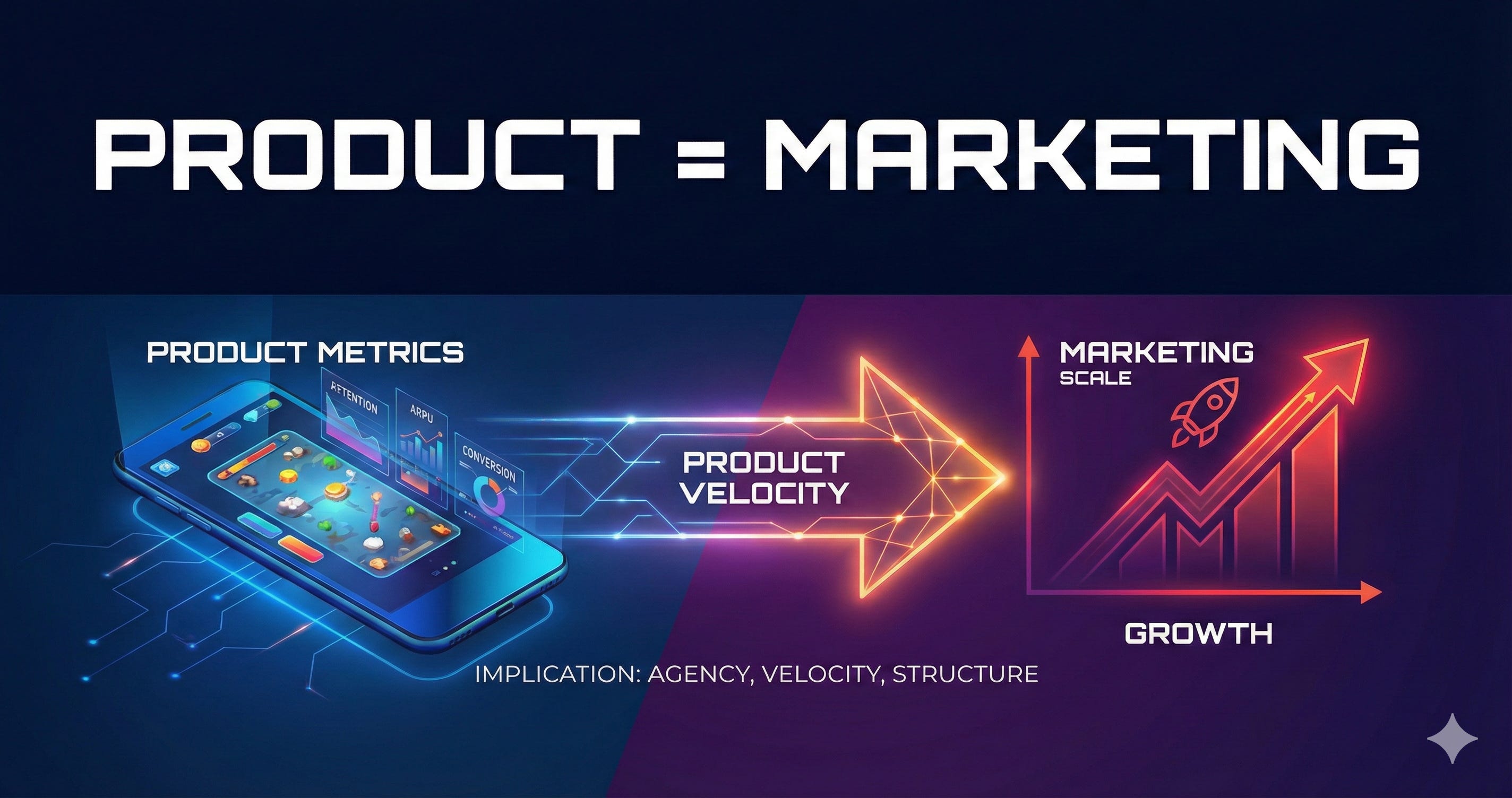
Today, I’m breaking down why “Product Is Marketing” and the three specific implications this has for your studio’s mindset, velocity, and organizational structure.
Why F2P Is Different
In retail, e-commerce, or SaaS, marketing and product can operate relatively independently. When Nike sells you a shoe, the transaction happens before you experience the product. Marketing creates desire, you pay, then you wear the shoe. If marketing is great, you might overpay for a mediocre product.
Premium games work the same way. I have over 300 games in my Steam library. I haven’t played the vast majority for more than 30 minutes. Publishers marketed to me successfully with products I didn’t actually engage with.
F2P mobile is fundamentally different.
The transaction happens during the product experience—often days or weeks after initial engagement. If your product doesn’t retain users and convert them to payers, no amount of marketing genius can save your unit economics. You’re just paying to acquire users who churn before they monetize.
Your retention curve, conversion rate, and ARPU aren’t just quality metrics. They determine your marketing budget. They are your marketing capability.
The Math That Dictates Your Ceiling
The relationship between CPI and ad spend volume is non-linear. As you scale spend from $100/day to $100,000/day, your CPI rises dramatically. At some point, it taps out. You get priced out of the auction.
If your LTV is mediocre, your marketing ceiling is low. If your LTV is superior, you can weaponize it.
The classic case study: Machine Zone (Game of War) vs. Kabam (Kingdoms of Camelot) in the early 2010s.
Kingdoms of Camelot was a successful 4X game with an LTV around $8-10 (according to word on the street at that time)—incredible for that era. Machine Zone copied the formula but studied Chinese MMOs, layering in aggressive monetization features like VIP tiers and gold banks. Game of War hit $12-15 in LTV (again, based on word on the street).
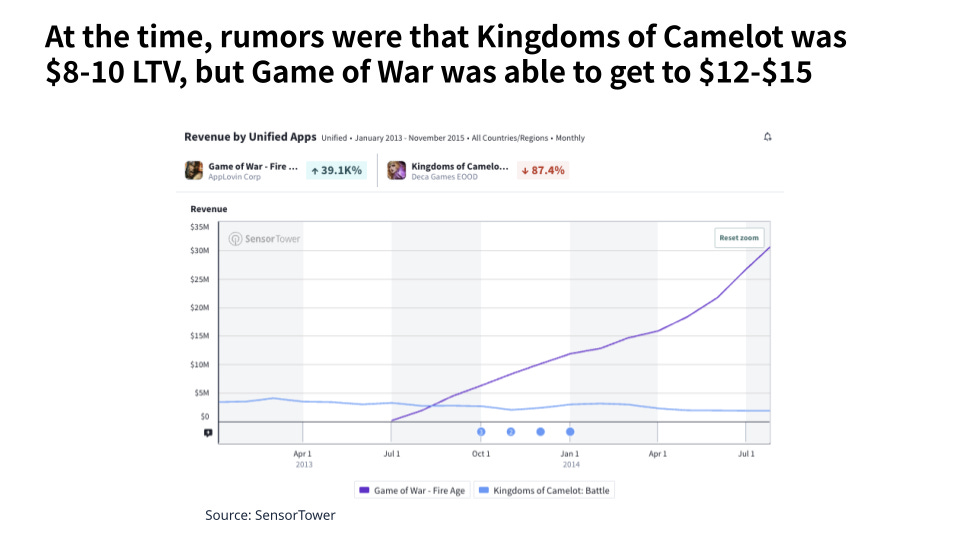
MZ used that delta to sweep ad inventory. They bid aggressively, monopolized the available supply, and effectively nuked Kingdoms of Camelot by starving it of traffic. Game of War’s LTV advantage became a weapon.
Product metrics don’t just measure health. They dictate your ability to compete.
Implication #1: From Fatalism to Agency
Too many teams treat product metrics like the weather—something that just “happens” to them.
The mindset is: “We built a great game. Now let’s soft launch and measure retention to see if it works. I hope the numbers are good.”
This is an attempt to divert accountability. It’s an intentional disassociation of the team’s effort from the outcome.
Here’s what’s odd: everyone agrees that soft launch is used to optimize product metrics. Teams work to drive these metrics. That’s not controversial. But then those same teams treat their ability to drive metrics as somehow separate from the product itself—as if the team is on one side and the results are on the other.
They’re not separate. They’re the same thing.
The winning mindset is agency and self-determinism. Dream Games didn’t stumble into Match-3 dominance. They run approximately 60 A/B tests annually. Aydemir said they spent “so much time on tiny details, so many tests over several years to create the dynamics of the game.”
Implication #2: Product Velocity Is the Killer Variable
If the product sets your marketing ceiling, how quickly you improve it determines how quickly you can scale marketing.
Product velocity is the killer variable. If it takes you months to implement a feature that should take weeks, you are dead in the water. If you can iterate faster than your runway burns, you win. If you can’t, you lose.

I struggle with this too. At my own studio, we recently spent 42 days getting product analytics (PostHog) into production. That should have taken a few days. Let me be clear: that lack of velocity puts us on a path to failure unless we fix it.
I’m not going to pretend it’s out of my control. It’s not fate. It’s me. It’s our team. It’s our ability to generate creative solutions and execute them with speed.
Velocity requires looking at your team with a critical eye. It means conducting a root cause analysis of why things are slow. Often, this means having uncomfortable conversations about people and processes—something that rarely happens because criticizing people at most organizations is playing with fire.
But if you don’t fix velocity, you cannot fix the metrics that unlock marketing scale.
Implication #3: The End of Silos
At most gaming companies, Marketing and Product are separate kingdoms. Different leaders, different meetings, different dashboards, different incentives.
This leads to the CYA game:
Marketing says: “CPI is low. We’re doing our job. The product just doesn’t retain.”
Product says: “Retention is fine. Marketing is bringing us garbage users.”
If Product is Marketing, this structure is obsolete. You’re creating artificial friction between two functions that need to operate as one system.
You need shared reporting—one leader owning the full loop from UA efficiency to monetization outcomes. You need shared dashboards—product must see UA data, UA must see product KPIs. And you need shared accountability—when the game fails to scale, it’s the team’s fault, not a specific department’s fault.
I know this is hard to implement, especially at larger companies with entrenched structures. But at minimum, get these teams in the same room, looking at the same data, with the same goals.
The Hopeful Flip Side
When Aydemir said it’s impossible to scale without good metrics, that’s the brutal truth of F2P mobile. But here’s the flip side:
If your product metrics are good enough, you can scale. Small teams can beat entrenched competitors with massive war chests. Royal Match competed in Match-3—one of the most competitive genres in mobile—and won.
Marketing is just execution. The product is the unlock.
And improving those metrics is within your team’s power. Not fate. Not luck. Ownership and relentless experimentation.
Because in mobile F2P, the product isn’t just what you sell—it’s how you sell it.
Takeaways
Your product metrics ARE your marketing budget. LTV determines how much you can spend to acquire users and how far you can scale before getting priced out. Better metrics = higher ceiling.
Stop treating metrics as lottery results. Dream Games runs 60+ A/B tests annually. The mindset of “let’s see if the product is good enough” is fatalism. Iterate until it’s good enough.
Product velocity is survival. If you can improve faster than your runway burns, you win. Fixing velocity means confronting uncomfortable truths about people and processes.
Kill the silos. Shared reporting, shared dashboards, shared accountability. When product and marketing blame each other, the real problem is your org chart.
Competitive advantage compounds. As Game of War demonstrated, even small LTV advantages let you outspend competitors and starve them of inventory. Product metrics aren’t just about profitability—they’re weapons.